MCQ
In an isothermal expansion
  • A
    Internal energy of the gas increases
  • B
    Internal energy of the gas decreases
  • Internal energy remains unchanged
  • D
    Average kinetic energy of gas molecule decreases

Answer

Correct option: C.
Internal energy remains unchanged
In isothermal expansion temperature remains constant, hence no change in internal energy.

Need a full question paper?

Generate a complete, print-ready paper with questions like this in minutes — across 16+ boards, with answer keys.
Start Generating Free

Similar questions

Two perfectly elastic particles $P$ and $Q$ of equal mass travelling along the line joining them with velocities $15 \mathrm{~m} / \mathrm{sec}$ and $10 \mathrm{~m} / \mathrm{sec}$. After collision, their velocities respectively (in $\mathrm{m} / \mathrm{sec}$ ) will be
A body takes 5 minutes to cool from $90^{\circ} \mathrm{C}$ to $60^{\circ} \mathrm{C}$. If the temperature of the surroundings is $20^{\circ} \mathrm{C}$, the time taken by it to cool from $60^{\circ} \mathrm{C}$ to $30^{\circ} \mathrm{C}$ will be.
A lens (focal length $50 \mathrm{~cm}$ ) forms the image of a distant object which subtends an angle of $1$ milliradian at the lens. What is the size of the image
In a double slit arrangement fringes are produced using light of wavelength $4800 \mathring A$. One slit is covered by a thin plate of glass of refractive index $1.4$ and the other with another glass plate of same thickness but of refractive index $1.7.$ By doing so the central bright shifts to original fifth bright fringe from centre. Thickness of glass plate is
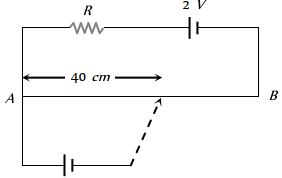
$A B$ is a potentiometer wire of length $100 \mathrm{~cm}$ and its resistance is $10$ ohms. It is connected in series with a resistance $R=40 \mathrm{ohms}$ and a battery of e.m.f. $2 V$ and negligible internal resistance. If a source of unknown e.m.f. $E$ is balanced by $40 \mathrm{~cm}$ length of the potentiometer wire, the value of $E$ is
Image
Least doped region in a transistor
A research satellite of mass $200 \mathrm{~kg}$ circles the earth in an orbit of average radius $3 R / 2$ where $R$ is the radius of the earth. Assuming the gravitational pull on a mass of $1 \mathrm{~kg}$ on the earth's surface to be $10 \mathrm{~N}$, the pull on the satellite will be
A man of length $h$ requires a mirror, to see his own complete image of length at least equal to
It is easier to draw up a wooden block along an inclined plane than to haul it vertically, principally because
At $127 \mathrm{C}$ radiates energy is $2.7 \times 10 \mathrm{~J} / \mathrm{s}$. At what temperature radiated energy is $4.32 \times 10 \mathrm{~J} / \mathrm{s}$