Question
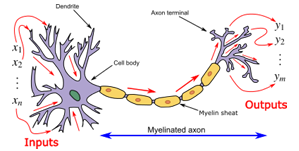
In animals, control and coordination are provided by nervous and muscular tissues. Touching a hot object is an urgent and dangerous situation for us. We need to detect it and respond to it. How do we detect that we are touching a hot object? All information from our environment is detected by the specialised tips of some nerve cells. These receptors are usually located in our sense organs, such as the inner ear, the nose, the tongue, and so on. So gustatory receptors will detect taste while olfactory receptors will detect the smell. This information, acquired at the end of the dendritic tip of a nerve cell, see figure, sets off a chemical reaction that creates an electrical impulse. This impulse travels from the dendrite to the cell body, and then along the axon to its end.
Image
(a) Name the largest cell present in the body.
(b) What is an axon?
(c) Name one gustatory receptor and one olfactory receptor present in a human beingsettings
OR
Name the following parts of a neuron:
a. Where information is acquired.
b. Through which information travels as an electrical impulse.

Answer

In animals, control and coordination are provided by nervous and muscular tissues. Touching a hot object is an urgent and dangerous situation for us. We need to detect it and respond to it. How do we detect that we are touching a hot object? All information from our environment is detected by the specialised tips of some nerve cells. These receptors are usually located in our sense organs, such as the inner ear, the nose, the tongue, and so on. So gustatory receptors will detect taste while olfactory receptors will detect the smell. This information, acquired at the end of the dendritic tip of a nerve cell, see figure, sets off a chemical reaction that creates an electrical impulse. This impulse travels from the dendrite to the cell body, and then along the axon to its end.
Image
(i) Nerve cell is the largest cell present in the body.
(ii) Axon is a large, single, unbranched nerve fibre arising from the cyton. It carries impulses from cyton located in CNS to the effectors.
(iii) Gustatory receptor: Taste buds on the tongue. The receptors for gustation are located in the oral cavity, which brings food and fluids from outside the body into the gastrointestinal tract.
Olfactory receptor: Receptor in the nose. These receptors are common to arthropods, terrestrial vertebrates, fish, and other animals.
OR
a. Dendrites.
b. Axon.

Need a full question paper?

Generate a complete, print-ready paper with questions like this in minutes — across 16+ boards, with answer keys.

Start Generating Free

Similar questions

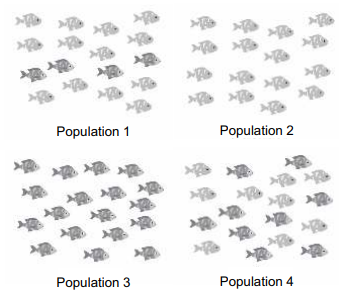
The diagram shows four different populations of a freshwater fish.
All fish belong to the same species but with two different adaptations.

Image
Image
1. Which population is most likely to survive a small increase in water salinity in its habitat?
A. Population 1
B. Population 2
C. Population 3
D. Population 4
2. Which of these is responsible for the difference in adaptation within the ish species?
Circle ‘Yes’ or ‘No’ to mark your response.

Is this responsible for the difference in adaptation?

Yes or No

Difference in food source

Yes/No

Variations in DNA

Yes/No

Difference in age

Yes/No

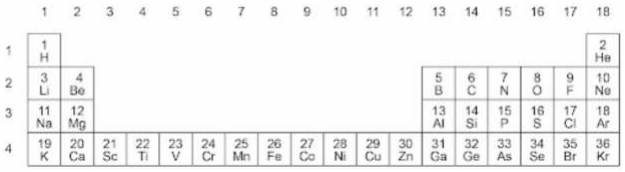
The picture shows a part of the periodic table.

Image
8. Which element has the highest metallic property?
A. F
B. Al
C. K
D. Fe
9. Which element shows the properties of both metals and non-metals?
A. H
B. Ne
C. Mg
D. As
10. Which of these oxides is acidic in nature?
A. So₂
B. CaO
C. Al₂O₃
D. Fe₂O₃

Read the following and answer any three questions from (i) to (iv).Mendeleev arranged the 63 elements known at that time in order of their ascending atomic masses and prepared a periodic table. Mendeleev's periodic table contains vertical columns called 'groups' and horizontal rows called 'periods'. Elements with similar properties were placed in same groups.
The basis of Mendeleev's classification is his periodic law, which states that:
  1. Atomic mass is the fundamental property of elements.
  2. The physical and chemical properties of elements are periodic function of their atomic masses.
  1. Which metals are not placed in the eighth group of Mendeleev's periodic table?
     
  2. ln Mendeleev's periodic table, gaps were left for the elements to be discovered later. Which of the elements found a place in the periodic table later?
     
  3. What is mandeleev's periodic table?

    OR
     
  4. What is difference between mendeleev and modern periodic table?
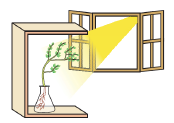
Fill a conical flask with water. Cover the neck of the flask with a wire mesh. keep two or three freshly germinated bean seeds on the wire mesh. Take a cardboard box which is open from one side. Keep the flask a wire mesh. Kin the box in such a manner that the open side of the box faces light coming from a window as shown in the given figure. After two or three days, you will notice that the shoots bend towards light and roots away from light. Now turn the flask so that the shoots are away from light and the roots towards the light. Leave it undisturbed in this condition for a few days. Plants show tropism in response to other stimuli as well. The roots of a plant always grow downwards while the shoots usually grow upwards and away from the earth. This upward and downward growth of shoots and roots, respectively, in response to the pull of earth or gravity, is obviously, geotropism.
Image

(a) What has represented by the given activities?
(b) Do old parts of the shoot and root change direction? Is there any difference in the direction of the new growth?
(c) What can we conclude from this activity?
OR
What is geotropism?
Read the following and answer any three questions from (i) to (iv).ln 1913, Henry Moseley showed that the atomic number of an element is the more fundamental property than its atomic mass. Accordingly, Mendeleev's periodic law was modified and atomic number was adopted as the basis of modem periodic table.
ln this periodic table, the elements are arranged in increasing order of their atomic numbers.
There are 18 vertical columns in the periodic table which constitute 18 groups or families. The groups are numbered as 1, 2, 3, ... upto 18. All the members of a particular group have similar outer shell electronic configuration. There are seven horizontal rows of the periodic table, which are known as periods.
  1. According to modern periodic law, the properties of elements are the periodic function of their __________
     
  2. All the elements in a period in the periodic table have the same_____________.
     
  3. a) Write the combinations of elements that belong to the same group?
    b) The atoms of elements belonging to the same group of periodic table have same number of__________.

    OR
  4. ln the periodic table, the element with atomic numbers 16, 24, and 35 will be respectively placed in the which group.
Salt of a strong acid and strong base is neutral with a pH value of 7. NaCl common salt is formed by a combination of hydrochloride and sodium hydroxide solution. This is the salt that is used in food. Some salt is called rock salt, bed of rock salt was formed when seas of bygone ages dried up. The common salt thus obtained is an important raw material for various materials of daily use, such as sodium hydroxide, baking soda, washing soda, and bleaching powder.
(a). If given acids are phosphoric acid, carbonic acid, hydrochloric acid and sulphuric acid, then which acid
does not form an acidic salt?
(b). What is the formula of baking soda?

OR

Name the substance which on treatment with chlorine to obtain bleaching powder.
Study the following table for a convex lens for different positions of object and answer the following questions:
Position of objectPosition of imageRelative size of image
At infinityAt focus F_(2)Highly diminished point sized
Beyond 2F_(1)Between F_(2) and 2F_(2)Diminished
At 2F_(1)At 2F_(2)Same size
Between F_(1) and 2F_(1)Beyond 2F_(2)Enlarged
At focus F_(1)At infinityInfinitely large or highly enlarged
Between focus F_(1) and optical centre OOn the same side of the lens as the objectEnlarged

(i) What is the nature of the image, if an object is placed at infinity ?
(ii) Identify the nature of the image for which the object is between focus and optical centre.
(iii) What is position of image, when object is place at focus $\left(f_1\right)$ ?
or
(iv) What is the focal length of a lens for an object placed $50 cm$ from the lens producing virtual image at a distance of $10 cm$ in front of the lens?

Read the following and answer any three questions from (i) to (iv).The rate of flow of charge is called electric current. The SJ unit of electric current is Ampere (A). The direction of flow of current is always opposite to the direction of flow of electrons in the current. The electric potential is defined as the amount of work done in bringing a unit positive test charge from infinity to a point in the electric field. The amount of work done in bringing a unit positive test charge from one point to another point in an electric field is defined as potential difference.
$\text{V}_{\text{AB}}=\text{V}_{\text{B}}-\text{V}_\text{A}=\frac{\text{W}_{\text{BA}}}{\text{q}}$
The SJ unit of potential and potential difference is volt.
  1. The 2C of charge is flowing through a conductor in 100ms, the current in the circuit will?
     
  2. Define electric current? what is the SJ unit of electric current.
     
  3. The potential difference between the two terminals of battery, if 100 joules of work is required to transfer 20 coulombs of charge from one terminal of the battery to other will?
OR
  1. a) Then number of electrons flowing per second in a conductor if I A current is passing through it?
    b) The voltage can be written as.
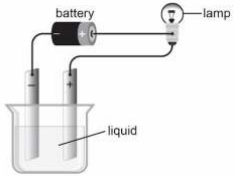
Mike placed an electric circuit separately in a dilute acid and a dilute base.

Image
Mike observed whether the lamp in the circuit glowed or not for each liquid.
8. Which property of acids and bases was Mike trying to test through his experiment?
9. Will the lamp glow if the circuit is placed in distilled water?
Explain your answer.
10. Acid + Metal →Salt + X
What is X in the equation?

Question numbers $i$ - iv are based on the table given below. Study the table and answer the following questions.
S. No.GenerationPhenotypic ratio
1.F_(1) generation23 pairs
2.F_(2) generation22 pairs

(i) State the law of dominance.
(ii) What is the dominant allele?
(iii) Define the term phenotype.
(iv) What is the meaning of genotype?