Questions

case /data -based (4 Marks)

🎯

Test yourself on this topic

3 questions · timed · auto-graded

Question 14 Marks
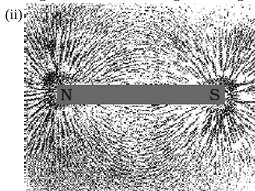
A student fixes a sheet of white paper on a drawing board using some adhesive materials. She places a bar magnet in the centre of it and sprinkles some iron filings uniformly around the bar magnet using a salt sprinkler. On tapping the board gently, she observes that the iron filings have arranged themselves in a particular pattern.
(a) What makes iron filings arrange in a definite pattern?
(b) Draw a diagram to show this pattern of iron filings.
(c) How is the direction of magnetic field at a point determined using the field lines? Why do two magnetic field lines not cross each other?
OR
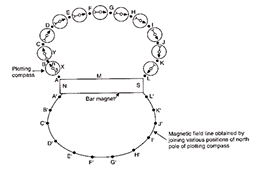
How are the magnetic field lines of a bar magnet drawn using a small compass needle? Draw one magnetic field line each on both sides of the magnet.
Answer
A student fixes a sheet of white paper on a drawing board using some adhesive materials. She places a bar magnet in the centre of it and sprinkles some iron filings uniformly around the bar magnet using a salt sprinkler. On tapping the board gently, she observes that the iron filings have arranged themselves in a particular pattern.
(i) The bar magnet kept at the centre of board has its magnetic field around it. The iron filings sprinkled on the board experience a force on them due to the magnetic field of bar magnet. So, when the student taps the board the iron filings align themselves according to the magnetic field lines of the bar magnet.
Image
(iii)The direction of a magnetic field at a point is determined by placing a small compass needle. The N-pole of compass indicates the direction of magnetic field at that point.
Two magnetic field lines do not intersect each other because if there was point of intersection, The compass needle would point towards 2 directions.
Image
View full question & answer
Question 24 Marks
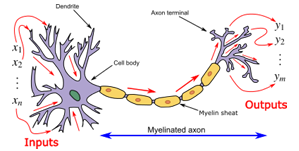
In animals, control and coordination are provided by nervous and muscular tissues. Touching a hot object is an urgent and dangerous situation for us. We need to detect it and respond to it. How do we detect that we are touching a hot object? All information from our environment is detected by the specialised tips of some nerve cells. These receptors are usually located in our sense organs, such as the inner ear, the nose, the tongue, and so on. So gustatory receptors will detect taste while olfactory receptors will detect the smell. This information, acquired at the end of the dendritic tip of a nerve cell, see figure, sets off a chemical reaction that creates an electrical impulse. This impulse travels from the dendrite to the cell body, and then along the axon to its end.
Image
(a) Name the largest cell present in the body.
(b) What is an axon?
(c) Name one gustatory receptor and one olfactory receptor present in a human beingsettings
OR
Name the following parts of a neuron:
a. Where information is acquired.
b. Through which information travels as an electrical impulse.
Answer
In animals, control and coordination are provided by nervous and muscular tissues. Touching a hot object is an urgent and dangerous situation for us. We need to detect it and respond to it. How do we detect that we are touching a hot object? All information from our environment is detected by the specialised tips of some nerve cells. These receptors are usually located in our sense organs, such as the inner ear, the nose, the tongue, and so on. So gustatory receptors will detect taste while olfactory receptors will detect the smell. This information, acquired at the end of the dendritic tip of a nerve cell, see figure, sets off a chemical reaction that creates an electrical impulse. This impulse travels from the dendrite to the cell body, and then along the axon to its end.
Image
(i) Nerve cell is the largest cell present in the body.
(ii) Axon is a large, single, unbranched nerve fibre arising from the cyton. It carries impulses from cyton located in CNS to the effectors.
(iii) Gustatory receptor: Taste buds on the tongue. The receptors for gustation are located in the oral cavity, which brings food and fluids from outside the body into the gastrointestinal tract.
Olfactory receptor: Receptor in the nose. These receptors are common to arthropods, terrestrial vertebrates, fish, and other animals.
OR
a. Dendrites.
b. Axon.
View full question & answer
Question 34 Marks
The teacher while conducting practicals in the laboratory divided the students into three groups and gave them various solutions to find out their pH and classify them into acidic, basic and neutral solutions.
Group A - Lemon juice, vinegar, colourless aerated drink
Group B - Tomato juice, coffee, ginger juice
Group C - Sodium hydroxide, sodium chloride, lime water
(a) For the solutions provided, which group is/are likely to have pH value (i) less than 7, and (ii) greater than 7?
(b) List two ways of determining pH of a solution.
OR
Explain, why the sour substances such as lemon juice are effective in cleaning the tarnished copper vessels.
Answer
The teacher while conducting practicals in the laboratory divided the students into three groups and gave them various solutions to find out their pH and classify them into acidic, basic and neutral solutions.
Group A - Lemon juice, vinegar, colourless aerated drink
Group B - Tomato juice, coffee, ginger juice
Group C - Sodium hydroxide, sodium chloride, lime water
(i) i. Groups A and B - less than 7
ii. Group C - greater than 7
(ii) pH paper and universal indicator.
OR
i. Copper vessel is tarnished due to formation of basic copper oxide.
ii. Lemon juice being acidic react with copper oxide and the salt formed is washed away.
View full question & answer
case /data -based (4 Marks) - Science STD 10 Questions - Vidyadip