Question
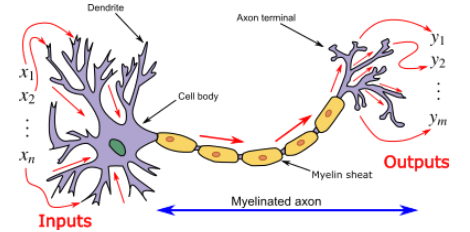
In animals, control and coordination are provided by nervous and muscular tissues. Touching a hot object is an urgent and dangerous situation for us. We need to detect it and respond to it. How do we detect that we are touching a hot object? All information from our environment is detected by the specialised tips of some nerve cells. These receptors are usually located in our sense organs, such as the inner ear, the nose, the tongue, and so on. So gustatory receptors will detect taste while olfactory receptors will detect the smell. This information, acquired at the end of the dendritic tip of a nerve cell, see figure, sets off a chemical reaction that creates an electrical impulse. This impulse travels from the dendrite to the cell body, and then along the axon to its end.
Image

(a) Name the largest cell present in the body.
(b) What is an axon ?
(c) Name one gustatory receptor and one olfactory receptor present in a human beings.

OR

Name the following parts of a neuron:
a. Where information is acquired.
b. Through which information travels as an electrical impulse.
Answer

In animals, control and coordination are provided by nervous and muscular tissues. Touching a hot object is an urgent and
dangerous situation for us. We need to detect it and respond to it. How do we detect that we are touching a hot object? All
information from our environment is detected by the specialised tips of some nerve cells. These receptors are usually located in our sense organs, such as the inner ear, the nose, the tongue, and so on. So gustatory receptors will detect taste while olfactory receptors will detect the smell. This information, acquired at the end of the dendritic tip of a nerve cell, see figure, sets off a chemical reaction that creates an electrical impulse. This impulse travels from the dendrite to the cell body, and then along the axon to its end.
Image

(i) Nerve cell is the largest cell present in the body.
(ii) Axon is a large, single, unbranched nerve fibre arising from the cyton. It carries impulses from cyton located in CNS to
the effectors.
(iii) Gustatory receptor: Taste buds on the tongue. The receptors for gustation are located in the oral cavity, which brings food and fluids from outside the body into the gastrointestinal tract.
Olfactory receptor: Receptor in the nose. These receptors are common to arthropods, terrestrial vertebrates, fish, and
other animals.

OR

a. Dendrites
b. Axon.

Need a full question paper?

Generate a complete, print-ready paper with questions like this in minutes — across 16+ boards, with answer keys.

Start Generating Free

Similar questions

The table lists the development of few characteristics in the human body.

Characteristics

growth of thick hair in the armpits of both males and females
cracking of voice in males
development of breasts in females

6. At which stage of human development do the above characteristics appear?
7. Which of these statements is true for the characteristics listed in the table above?
Circle ‘Yes’ or ‘No’ to mark your response.

Is this statement true?

Yes or No

The characteristics generally develop earlier in girls than boys.

Yes/No

The characteristics develop over a span of few years.

Yes/No

The characteristics last for a short time.

Yes/No


There are different types of chemical reactions occurring around us or being carried out for the benefit of mandkind, e.g. combination reactions, decomposition reactions, displacement reactions, precipitation reactions, reduction-oxidation (redox) reactions, photochemical reactions etc.
Now, answer the following questions :
  1. Combustion of coke is a combination reaction. $CO _2$ is not a pollutant. Then, why is combustion of coke harmful?
  2. Which reaction followed by two combination reactions are involved in white wash of walls?
  3. Give one use of tin plating in daily life.
    or
    How photochemical reactions have played an important in photography?
Read the following and answer any three questions from (i) to (iv). A series of organic compounds having same functional group, with similar or almost identical chemical characteristics in which all the members can be represented by the same general formula and the two consecutive members of the series differ by- $CH _2$ group or 14 mass unit in their molecular formulae is called a homologous series. For example, all the members of alcohol family can be represented by the general formula, $C _n H _{2 n+1} OH$ where, $n$ may have the values $1,2,3$, etc. The various members of a particular homologous series are called homologous. The physical properties such as density, melting point, boiling point, solubility, etc. of the members of a homologous series show almost regular variation in ascending or descending the series.
i. What are the characteristic of members of a homologous series?
ii. Write the general formula of all the members of homologous series of alkynes.
iii. What is a homologous series? Write example.
OR
iv. What are the 3 types of homologous series and define each.
A student fixes a sheet of white paper on a drawing board using some adhesive materials. She places a bar magnet in the centre of it and sprinkles some iron filings uniformly around the bar magnet using a salt-sprinkler. On tapping the board gently, she observes that the iron filings have arranged themselves in a particular pattern.
(a) Draw a diagram to show this pattern of iron filings.
(b) Draw the magnetic field lines of a bar magnet showing the poles of the bar magnet as well as the direction of the magnetic field lines.
(c) How is the direction of magnetic field at a point determined using the field lines? Why do two magnetic field lines not cross each other?OR
How are the magnetic field lines of a bar magnet drawn using a small compass needle? Draw one magnetic field line each on both sides of the magnet.
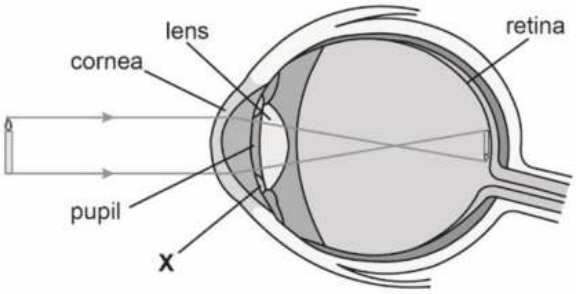
The diagram shows how a human eye sees a candle.

Image
1. What is X?<
2. Which part of the eye produces maximum refraction of light rays?
A. Lens
B. Pupil
C. Retina
D. Cornea
3. What type of image is formed on the retina?
A. Virtual and inverted
B. Real and inverted
C. Virtual and erect
D. Real and erect
4. What would the size of the image formed on the retina depend on?
A. Age of the person
B. Curvature of the lens
C. ocal length of the lens
D. Distance of the candle from the eyes
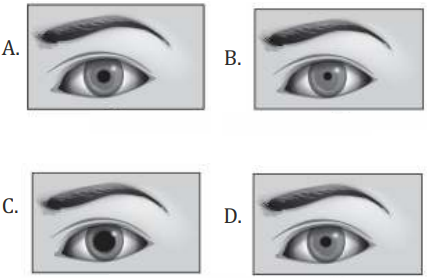
5. Which eye is likely to be in the brightest light?

Image
6. Which part of the eye controls the size of the pupil?
7. Presbyopia is a defect in vision.
What is the primary cause of presbyopia?
8. A young person can clearly see nearby objects but not distant objects.
Which of these statements is true for the person?
Circle ‘Yes’ or ‘No’ to mark your responses.

Is this statement correct?

Yes or No

His eye lens is not lexible.

Yes/No

His eyeballs are elongated.

Yes/No

All chromosomes in human cells are found in pairs.

Yes/No

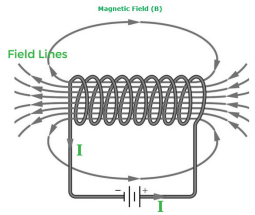
An insulated copper wire wound on a cylindrical cardboard tube such that its length is greater than its diameter is called a solenoid. When an electric current is passed through the solenoid, it produces a magnetic field around it. The magnetic field produced by a current-carrying solenoid is similar to the magnetic field produced by a bar magnet. The field lines inside the solenoid are in the form of parallel straight lines. The strong magnetic field produced inside a current-carrying solenoid can be used to magnetize a piece of a magnetic material like soft iron when placed inside the solenoid. The strength of the magnetic field produced by a current-carrying solenoid is directly proportional to the number of turns and strength of the current in the solenoid.

Image
(a) What would be the strength of the magnetic field inside a long current-carrying straight solenoid?
(b) Which end is north and which end is south pole when current flows through a solenoid?
(c) A long solenoid carrying a current produces a magnetic field B along its axis. If the current is double and
the number of turns per cm is halved, then what will be the new value of the magnetic field?

OR

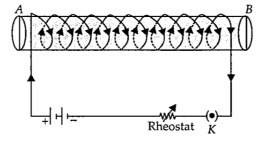
A soft iron bar is enclosed by a coil of insulated copper wire as shown in the figure. When the plug of the
key is closed, then where would the face B of the iron bar be marked?

Image
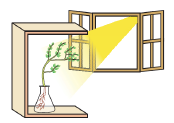
Fill a conical flask with water. Cover the neck of the flask with a wire mesh. keep two or three freshly germinated bean seeds on the wire mesh. Take a cardboard box which is open from one side. Keep the flask a wire mesh. Kin the box in such a manner that the open side of the box faces light coming from a window as shown in the given figure. After two or three days, you will notice that the shoots bend towards light and roots away from light. Now turn the flask so that the shoots are away from light and the roots towards the light. Leave it undisturbed in this condition for a few days. Plants show tropism in response to other stimuli as well. The roots of a plant always grow downwards while the shoots usually grow upwards and away from the earth. This upward and downward growth of shoots and roots, respectively, in response to the pull of earth or gravity, is obviously, geotropism.
Image

(a) What has represented by the given activities?
(b) Do old parts of the shoot and root change direction? Is there any difference in the direction of the new growth?
(c) What can we conclude from this activity?
OR
What is geotropism?

Read the following and answer any four questions from (i) to (v).
Gregor Mendel conducted hybridisation experiments on garden peas for seven years and proposed the laws of inheritance in living organisms. He investigated characters in the garden pea plant that were manifested as two opposing traits, e.g., tall or dwarf plants, yellow and green seeds, etc.
  1. Among the seven pairs of contrasting traits in pea plant as studied by Mendel, the number of traits related to flower, pod and seed respectively were.
  1. 2, 2, 2
  2. 2, 2, 1
  3. 1, 2, 2
  4. 1, 1, 2
  1. Tile colour based contrasting traits in seven contrasting pairs, studied by Mendel in pea plant were.
  1. 1
  2. 2
  3. 3
  4. 4
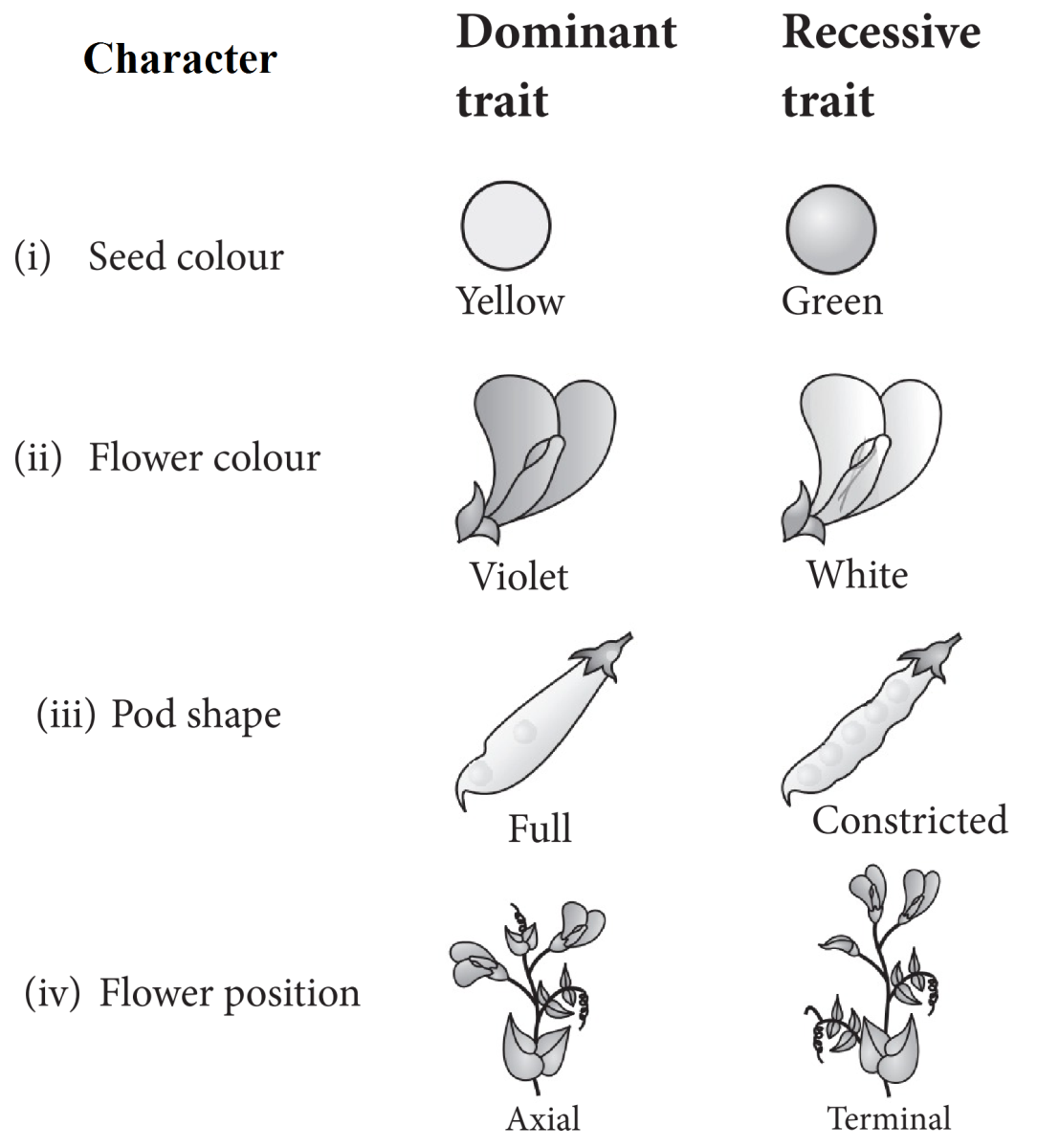
  1. Refer to the given table of contrasting traits in pea plants studied by Mendel.

Which of the given traits is correctly placed?
  1. (i), (ii) and (iii) only
  2. (ii), (iii) and (iv) only
  3. (ii) and (iii) only
  4. (i), (ii), (iii) and (iv)
  1. Some of the dominant traits studied by Mendel were.
  1. Round seed shape, green seed colour and axial flower position.
  2. Terminal flower position, green pod colour and inflated pod shape.
  3. Violet flower colour, green pod colour and round seed shape.
  4. Wrinkled seed shape, yellow pod colour and axial flower position.
  1. Which of the following characters was not chosen by Mendel?
  1. Pod shape.
  2. Pod colour.
  3. Position of flower.
  4. Position of pod.
During respiration in an organism A, one molecule of glucose produces 2 ATP molecules whereas in respiration of another organism B, one molecule of glucose produces 38 ATP molecules.
i. Which organism is undergoing aerobic respiration?
ii. Which organism is undergoing anaerobic respiration?
iii. Which type of organism A or B can convert glucose into alcohol?
iv. Name one organism which behaves like A.
v. Name one organism which behaves like B.
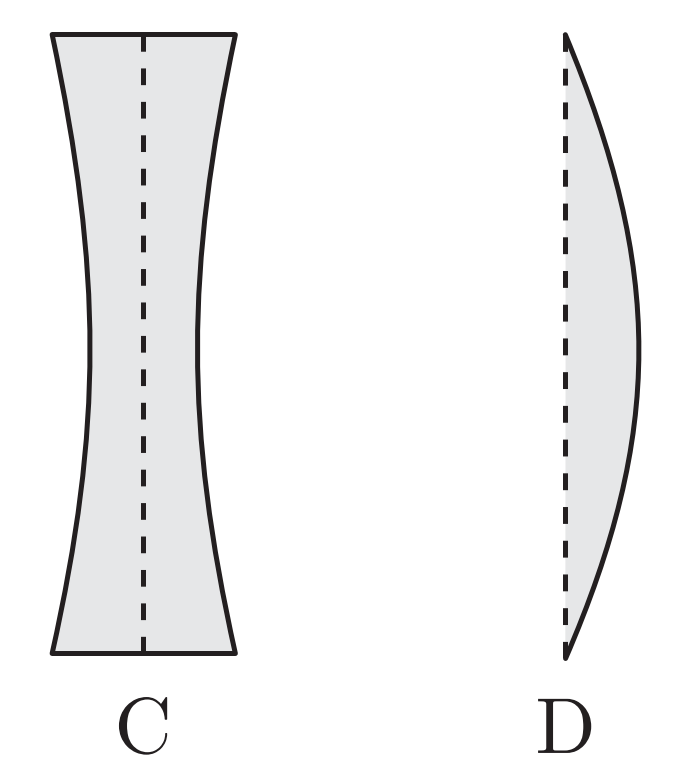
Lenses are objects made of transparent materials such as glass or clear plastic that has curved surfaces. Diverging lenses are thicker at their edges than at their centres and makes light rays passing through them spread out. Converging lenses are thicker in their middle than at this edges and make light rays passing through them focus at a point. These are used in spectacles to help people with poor vision see better. The converging lenses magnify by bending the rays of light that pass through them to meet at a point called focus. Thicker the converging lens is at its centre, the more its magnifies and closer the focus is to the lens.
(i) Ravi uses two lenses $A$ and $B$ of same size and same material as shown. $P _1$ and $P _2$ are the powers of $A$ and B. An object is kept at the same distance from the lens between $F$ and $2 F$ of each lens on the principal axis in turn. Let $I_1$ and $I_2$ be the image formed by two lenses respectively. What is the relation of image distances of both lens?
(ii) Write down the relation between the power of lens of both lenses ?
(iii) Meenakshi uses above two lenses $A$ and $B$ along with another two lenses $C$ and $D$, as shown :


She is able to see the subject matter on the black board while sitting in the front row in the classroom but is unable to see the same matter while sitting in the last row.
Which of the above four lenses will she require to correct the defect in her vision? Why ?
or
(iv) Natasha places an object on the principal axis of above given lens A. One end of this object coincides with the focus $F$ and the other end with $2 F$. What will be the nature of the image formed by the lens on the other side?