Questions

case /data -based (4 Marks)

🎯

Test yourself on this topic

3 questions · timed · auto-graded

Question 14 Marks
Answer
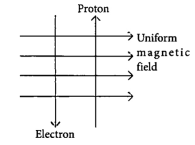
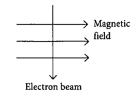
Andre Marie Ampere suggested that a magnet must exert an equal and opposite force on a current-carrying conductor, which was experimentally found to be true. But we know that current is due to charges in motion. Thus, it is clear that a charge moving in a magnetic field experience a force, except when it is moving in a direction parallel to it. If the direction of motion is perpendicular to the direction of magnetic field, the magnitude of force experienced depends on the charge, velocity (v), strength of magnetic field (B), and sine of the angle between v and B. Direction of magnetic force is given by Fleming’s left-hand rule.
Image

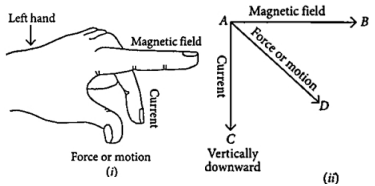
(i) Fleming’s left-hand rule is used to determine the direction of force on electron i.e., in south direction.
(ii) Force = q (V B) = qVB sin0
Where, 0 is angle between velocity and magnetic field.
So, sin0 is maximum when 0 is 90°
or velocity is perpendicular to magnetic field.
(iii) As the direction of current is taken opposite to the direction of motion of electrons, therefore, current from the motion of
electron and proton is in the same direction, i.e., from bottom to top. Now, according to Fleming’s left-hand rule, the electron and the proton experience forces both pointing into the plane of paper.

OR

We know that both the directions are perpendicular, thus for force direction = ?
Using Fleming's left-hand rule
Direction of force is perpendicular to the direction of magnetic field and current.
Thus direction of force is opposite to electron motion into the page at 90°
View full question & answer
Question 24 Marks
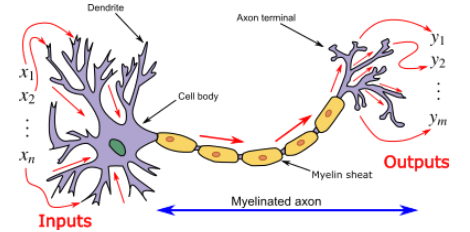
In animals, control and coordination are provided by nervous and muscular tissues. Touching a hot object is an urgent and dangerous situation for us. We need to detect it and respond to it. How do we detect that we are touching a hot object? All information from our environment is detected by the specialised tips of some nerve cells. These receptors are usually located in our sense organs, such as the inner ear, the nose, the tongue, and so on. So gustatory receptors will detect taste while olfactory receptors will detect the smell. This information, acquired at the end of the dendritic tip of a nerve cell, see figure, sets off a chemical reaction that creates an electrical impulse. This impulse travels from the dendrite to the cell body, and then along the axon to its end.

Image

(a) Name the largest cell present in the body.
(b) What is an axon ?
(c) Name one gustatory receptor and one olfactory receptor present in a human beings.

OR

Name the following parts of a neuron:
a. Where information is acquired.
b. Through which information travels as an electrical impulse.
Answer
In animals, control and coordination are provided by nervous and muscular tissues. Touching a hot object is an urgent and
dangerous situation for us. We need to detect it and respond to it. How do we detect that we are touching a hot object? All
information from our environment is detected by the specialised tips of some nerve cells. These receptors are usually located in our sense organs, such as the inner ear, the nose, the tongue, and so on. So gustatory receptors will detect taste while olfactory receptors will detect the smell. This information, acquired at the end of the dendritic tip of a nerve cell, see figure, sets off a chemical reaction that creates an electrical impulse. This impulse travels from the dendrite to the cell body, and then along the axon to its end.
Image

(i) Nerve cell is the largest cell present in the body.
(ii) Axon is a large, single, unbranched nerve fibre arising from the cyton. It carries impulses from cyton located in CNS to
the effectors.
(iii) Gustatory receptor: Taste buds on the tongue. The receptors for gustation are located in the oral cavity, which brings food and fluids from outside the body into the gastrointestinal tract.
Olfactory receptor: Receptor in the nose. These receptors are common to arthropods, terrestrial vertebrates, fish, and
other animals.

OR

a. Dendrites
b. Axon.
View full question & answer
Question 34 Marks
A scale for measuring hydronium ion in a solution is called the pH scale. The pH of a neutral solution is 7. A value of less than 7 on the pH scale represents an acidic solution. As the pH value, increases from 7 to 14 it represents OH- ion concentration in solution i.e a basic solution.
Image

(a) What is the pH range of the Human Body?
(b) The strength of acid and bases depends on which factor?

OR

If the pH of soil X is 7.5 while that of soil Y is 4.5, then which soil should be treated with powdered chalk to adjust its pH?
Answer
A scale for measuring hydronium ion in a solution is called the pH scale. The pH of a neutral solution is 7. A value of less than 7
on the pH scale represents an acidic solution. As the pH value, increases from 7 to 14 it represents OH- ion concentration in
solution i.e a basic solution.

Image
(i) The pH range of the Human Body is 7 to 7.8.
(ii) The strength of acids and bases depends on the number of $H ^{+}$ions produced and the number of $OH ^{-}$ ions produced.

OR

Soil Y is acidic. Hence, it should be treated with powdered chalk to reduce its acidity.
View full question & answer
case /data -based (4 Marks) - Science STD 10 Questions - Vidyadip
