MCQ
In aqueous solution, strong electrolytes
  • A
    Are partially ionized
  • B
    Do not ionise
  • Ionise almost completely
  • D
    Form polymers

Answer

Correct option: C.
Ionise almost completely
c
(c)Strong electrolytes are almost completely ionised in polar solvent.

Need a full question paper?

Generate a complete, print-ready paper with questions like this in minutes — across 16+ boards, with answer keys.
Start Generating Free

Similar questions

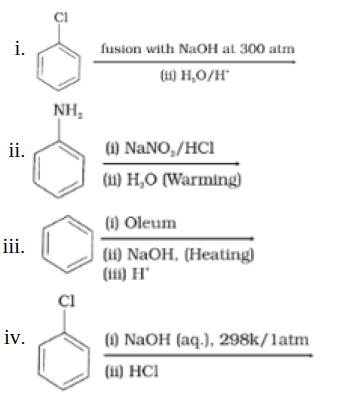
Which of the following reactions will yield phenol?
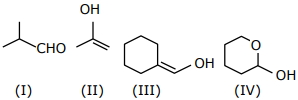
Image
Which among the above compound/s does/do not form Silver mirror when treated with Tollen's reagent?
What changes does not occur when $K_2Cr_2O_7$ react with $H_2O_2$ solution
A solution of m-chloroaniline, $m-$chlorophenol and $\mathrm{m}$ -chlorobenzoic acid in ethyl acetate was extracted initially with a saturated solution of $\mathrm{NaHCO}_{3}$ to give fraction $\mathrm{A}$. The left over organic phase was extracted with dilute $NaOH$ solution to give fraction $\mathrm{B}$. The final organic layer was labelled as fraction $\mathrm{C}$. Fractions $\mathrm{A},\mathrm{B}$ and $\mathrm{C},$ contain respectively 
An excess of $AgNO_3$ is added to $100\, mL$ of a $0.01\, M$ solution of dichlorotetraaqua- chromium $(III)$ chloride. The number of moles of $AgCl$ precipitated would be
Number of $Cl^-$ ions satisifying both primary and secondary valency are in $\ce{CoCl_3​.5NH_3}​.$
Assertion : $DNA$ as well as $RNA$ molecules are found in the nucleus of a cell.
Reason : On heating, the enzymes do not lose their specific activity.
Gabriel's phthalimide synthesis is used for the preperation of:
Moles of conc.$HNO_3$ required to oxidise one mole sulphur is :

$S + HNO_3 \rightarrow  H_2SO_4 + 6NO_2 + 2H_2O$

Which one of the following reducing agents is likely to be the most effective in bringing about the following change

$R - \mathop {\mathop {C\,N{H_2} \to RC{H_2}N{H_2}}\limits^{||\,\,\,\,\,\,\,\,\,\,\,\,\,\,\,\,\,\,\,\,\,\,\,\,\,\,\,\,\,\,\,\,\,\,\,\,\,\,\,\,\,\,\,\,\,\,\,\,\,\,\,} }\limits^{O\,\,\,\,\,\,\,\,\,\,\,\,\,\,\,\,\,\,\,\,\,\,\,\,\,\,\,\,\,\,\,\,\,\,\,\,\,\,\,\,\,\,\,\,\,\,\,\,\,} $