Question
In Boyle's law what remains constant

Answer

Boyle's law states that at coustant temperature, the volume of a given mass of a dry gas is inversely proportional to its pressure.

i.e., $V \propto \frac{1}{P}$

$\therefore P V=$ constant

Correct choice - option- $A$

Need a full question paper?

Generate a complete, print-ready paper with questions like this in minutes — across 16+ boards, with answer keys.
Start Generating Free

Similar questions

Two condensers of capacity $0.3\,\mu F$ and $0.6\,\mu F$ respectively are connected in series. The combination is connected across a potential of $6\,volts$. The ratio of energies stored by the condensers will be
Initially a gas of diatomic molecules is contained in a cylinder of volume $V _{1}$ at a pressure $P_{1}$ and temperature $250\, K$. Assuming that $25 \%$ of the molecules get dissociated causing a change in number of moles. The pressure of the resulting gas at temperature $2000\, K ,$ when contained in a volume $2 V _{1}$ is given by $P _{2}$. The ratio $\frac{P _{2}}{  P _{1}}$ is.
A wire of length $100\, cm$ is connected to a cell of $emf$ $2\, V$ and negligible internal resistance. The resistance of the wire is $3\, \,\Omega$. The additional resistance required to produce a potential drop of $1$ milli volt per cm is ............... $\Omega $
In a cyclic process, the internal energy of the gas
Five equal forces of $10 \,N$ each are applied at one point and all are lying in one plane. If the angles between them are equal, the resultant force will be ........... $\mathrm{N}$
The ratio of specific charge of an $\alpha $ -particle to that of a proton is
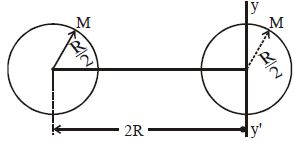
Two hollow spheres each of mass $M$ and radius $\frac {R}{2}$ are connected with a massless rod of length $2R$ as shown in figure. What will be the moment of inhertia of the system about an axis $yy'$ passing through the center of one of the sphere and perpendicular to the rod
$X $ and $Y$ are large, parallel conducting plates closed to each other. Each face has an area $A$. $X$ is given a charge $Q$. $Y$ is without any charge. Points $A, B$ and $C$ are as shown in figure. 
A dimensionless quantity is constructed in terms of electronic charge $e$, permittivity of free space $\varepsilon_0$, Planck's constant $h$, and speed of light $c$. If the dimensionless quantity is written as $e^\alpha \varepsilon_0^\beta h^7 c^5$ and $n$ is a non-zero integer, then $(\alpha, \beta, \gamma, \delta)$ is given by
Two wires with resistances $R$ and $2R$ are connected in parallel, the ratio of heat generated in $2R$ and $R$ is