MCQ
In $C + {H_2}O\, \to \,\,CO + {H_2},\,\,{H_2}O$ acts as
  • Oxidising agent
  • B
    Reducing agent
  • C
    $(a)$  and $(b)$  both
  • D
    None of these

Answer

Correct option: A.
Oxidising agent
(a) In this reaction ${H_2}O$ acts as oxidising agent.

Need a full question paper?

Generate a complete, print-ready paper with questions like this in minutes — across 16+ boards, with answer keys.

Start Generating Free

Similar questions

Ferrous ion can be oxidised by which of the following ions ?
The correct decreasing order for metallic character is
Which of the following alkane is synthesized from single alkyl halide by wurtz reaction ?
$CH_3Cl \to CH_4$
Above conversion can be achieved by
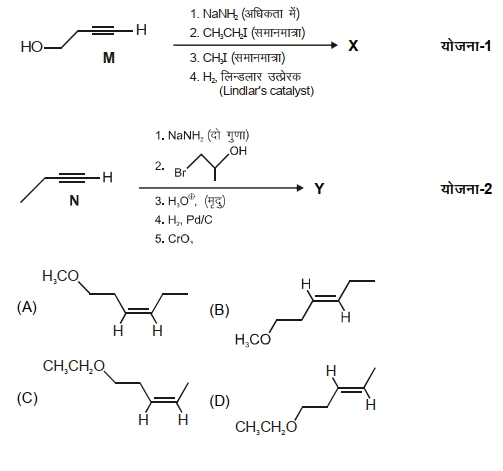
Schemes $1$ and $2$ describe sequential transformation of alkynes $M$ and $N$. Consider only the major products formed in each step for both the schemes. $Image$

$1.$ The product $X$ is

mcq $Image$

$2.$ The correct statement with respect to product $Y$ is :

$(A)$ It gives a positive Tollens test and is a functional isomer of $X$.

$(B)$ It gives a positive Tollens test and is a geometrical isomer of $X$.

$(C)$ It gives a positive iodoform test and is a functional isomer of $X$.

$(D)$ It gives a positive iodoform test and is a geometrical isomer of $X$.

Give the answer question $1$ and $2.$
$pH$ of completely dissociated $0.005\,M\,{H_2}S{O_4}$ is
Based on equation $E = - 2.178 \times 10^{-18} \ J \ \left( {\frac{{{Z^2}}}{{{n^2}}}} \right)$  certain conclusions are written. Which of themis not correct?
Benzene $ + \,\begin{array}{*{20}{c}}
  {\begin{array}{*{20}{c}}
  {\,\,\,\,\,\,C{H_3}\,\,\,\,\,\,\,\,\,\,\,\,\,\,\,\,\,\,\,\,\,\,\,\,\,\,} \\ 
  {|\,\,\,\,\,\,\,\,\,\,\,\,\,\,\,\,\,\,\,\,\,\,\,\,\,} 
\end{array}\,\,\,\,} \\ 
  {C{H_3} - C - C{H_2} - Cl\xrightarrow{{AlC{l_3}}}} \\ 
  {|\,\,\,\,\,\,\,\,\,\,\,\,\,\,\,\,\,\,\,\,\,\,\,\,\,\,\,\,\,} \\ 
  {C{H_3}\,\,\,\,\,\,\,\,\,\,\,\,\,\,\,\,\,\,\,\,\,\,\,\,} 
\end{array}$  Major product
The transitional metal which shows oxidation state from $+2$  to $+7 $ belong to group
$C_7H_9N$ has how many isomeric forms that contain a benzene ring