Question

In case of a semiconductor, which of the following statement is wrong

(a) Doping increases conductivity

(b) Temperature coefficient of resistance is negative

(c) Resisitivity is in between that of a conductor and insulator

(d) At absolute zero temperature, it behaves like a conductor

Answer

(d) At absolute zero temperature, it behaves like a conductor

Need a full question paper?

Generate a complete, print-ready paper with questions like this in minutes — across 16+ boards, with answer keys.

Start Generating Free

Similar questions

In X-ray spectrum wavelength   of line   depends on atomic number Z as

(a)   

(b)  

(c)

(d)

Electric lines of force about negative point charge are

(a) Circular, anticlockwise

(b) Circular, clockwise

(c) Radial, inward

(d) Radial, outward

Two nucleons are at a separation of 1 . The net force between them is , if both are neutrons,  if both are protons and   if one is a proton and other is a neutron. In such a case

(a)  

(b)  

(c)  

(d)  

The ionisation energy of 10 times ionised sodium atom is

(a) 13.6 eV

(b) 13.6 × 11 eV

(c)  

(d) 13.6 × (11)2 eV

If the current is doubled, the deflection is also doubled in

(a) A tangent galvanometer

(b) A moving coil galvanometer

(c) Both (a) and (b)

(d) None of these

Which of the following is an example of a non-ohmic conductor?

A parallel plate condenser with oil between the plates (dielectric constant of oil K = 2) has a capacitance C. If the oil is removed, then capacitance of the capacitor becomes

(a)    

(b) 2C

(c)  

(d)  

A point charge +q  is placed at the centre of a cube of side L. The electric flux emerging from the cube is

(a)  

(b) Zero

(c)

(d)

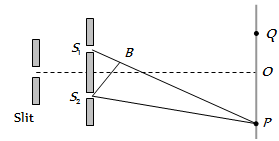
In the figure is shown Young’s double slit experiment. Q is the position of the first bright fringe on the right side of O. P is the 11th fringe on the other side, as measured from Q. If the wavelength of the light used is 6000 ,  then   will be equal to

(a) 6  

(b) 6.6  

(c) 3.138  

(d) 3.144  

During mean life of a radioactive element, the fraction that disintegrates is

(a) e 

(b)  

(c)  

(d)