In damped oscillations, damping force is directly proportional to speed of oscillator. If amplitude becomes half of its maximum value in $1 \,s$, then after $2 \,s$ amplitude will be $\left(A_0-\right.$ initial amplitude)
Medium


Download our appand get started for free
Experience the future of education. Simply download our apps or reach out to us for more information. Let's shape the future of learning together!No signup needed.*
Similar Questions
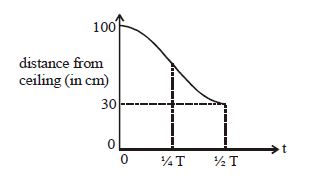
- 1A spring hangs vertically from the ceiling and a mass is attached to its free end. When the mass is pulled down and released, it oscillates vertically with simple harmonic motion of period $T$ . The variation with time $t$ of its distance from the ceiling is as shown. Which statement gives a correct deduction from this graph?View Solution
- 2A particle is subjected to two mutually perpendicular simple harmonic motions such that its $x$ and $y$ coordinates are given by ?View Solution
$ x = 2 \sin \omega t \,;$ $ y = 2 \sin \left( {\omega t + \frac{\pi }{4}} \right)$
The path of the particle will be :
- 3An object is attached to the bottom of a light vertical spring and set vibrating. The maximum speed of the object is $15\, cm/sec$ and the period is $628$ milli-seconds. The amplitude of the motion in centimeters isView Solution
- 4If $A$ is the area of cross-section of a spring $L$ is its length $E$ is the Young's modulus of the material of the spring then time period and force constant of the spring will be respectivelyView Solution
- 5A block of mass $0.1\, kg$ is connected to an elastic spring of spring constant $640\, Nm^{-1}$ and oscillates in a damping medium of damping constant $10^{-2}\, kg\,s^{-1}$ . The system dissipates its energy gradually. The time taken for its mechanical energy of vibration to drop to half of its initial value, is closest to ..... $s$View Solution
- 6A particle moves in the $x-y$ plane according to equation $\overrightarrow r = (\widehat i + 2\widehat j)\, A \, \cos \omega t$. The motion of the particle isView Solution
- 7A spring of force constant $k$ is cut into two pieces such that one piece is double the length of the other. Then the long piece will have a force constant ofView Solution
- 8Two masses $m_1$ and $m_2$ connected by a spring of spring constant $k$ rest on a frictionless surface. If the masses are pulled apart and let go, the time period of oscillation isView Solution
- 9If the displacement of a particle executing $SHM $ is given by $y = 0.30\sin (220t + 0.64)$ in metre, then the frequency and maximum velocity of the particle isView Solution
- 10The length of the second pendulum on the surface of earth is $1\, m$. The length of seconds pendulum on the surface of moon, where g is 1/6th value of $g$ on the surface of earth, isView Solution