Question
In ∆ABC,∠ACB is obtuse angle, seg AD ⊥ seg BC. Prove that:
AB² = BC² + AC² - 2BC×CD

Answer

Get the step-by-step solution for this question inside the Vidyadip app.

Get the answer in the app

Need a full question paper?

Generate a complete, print-ready paper with questions like this in minutes — across 16+ boards, with answer keys.
Start Generating Free

Similar questions

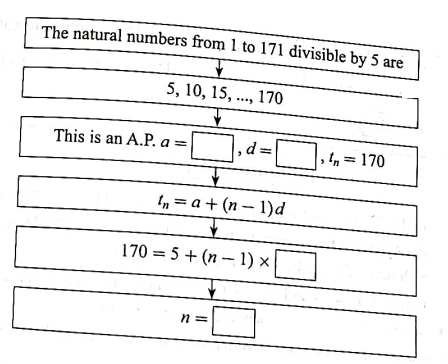
Complete the following activity to find the number of natural numbers from 1 to 171 which are divisible by 5 .
Image
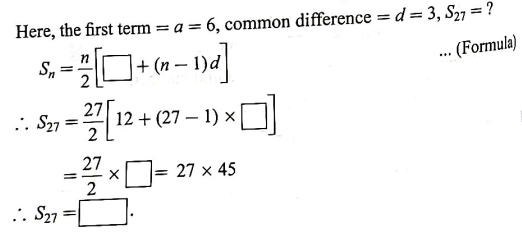
The first term and the common difference of an A.P. are 6 and 3 respectively. Find $S_{27}$.

Image
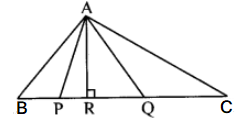
Find $\frac{A(\triangle A B C)}{A(\triangle A P Q)}$
Image
Solution :
In ∆ABC, BC is the base and AR is the height.
In ∆APQ, PQ is the base and AR is the height.
[The ratio of areas of two triangles is equal to the ratio of the product of their bases and corresponding heights]
$\therefore \frac{ A (\triangle ABC )}{ A (\triangle APQ )}=\frac{ ⬜ \times ⬜ }{ ⬜ \times ⬜ }$
$\therefore \frac{ A (\triangle ABC )}{ A (\triangle APQ )}=\frac{ ⬜ }{⬜}$
Write the values of the following trigonometric ratios.
$\tan 45^{\circ}=\frac{⬜}{⬜}$
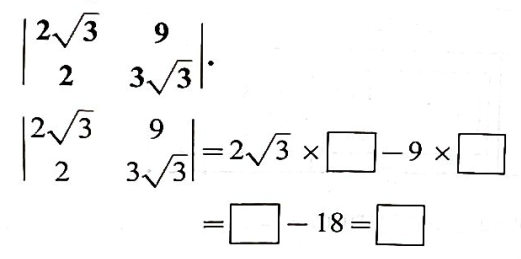
Complete the activity to find the value of the determinant
Image
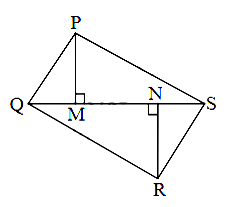
In fig., $PM = 10 cm, A(\triangle PQS) = 100$ sq.cm, $A(\triangle QRS) = 110$ sq.cm, then $NR?$


$\triangle P Q S$ and $\triangle Q R S$ having seg $Q S$ common base.
Areas of two triangles whose base is common are in proportion of their corresponding
$ \frac{ A ( PQS )}{ A ( QRS )}=\frac{[}{ NR }$
$\frac{100}{110}=\frac{[}{ NR },$
$NR =[\ldots] cm $
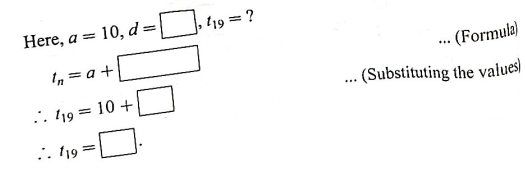
Complete the following activity to find the 19th term of the A.P. 10, 15, 20,..........
Image
If $\sec \theta+\tan \theta=\sqrt{3}$, complete the activity to find the value of $\sec \theta-\tan \theta$
Activity:
$ \square=1+\tan ^2 \theta \quad \ldots . . .[\text { Fundamental trigonometric identity] }$
$\square-\tan ^2 \theta=1$
$(\sec \theta+\tan \theta) \cdot(\sec \theta-\tan \theta)=\square$
$\sqrt{3} \cdot(\sec \theta-\tan \theta)=1$
$(\sec \theta-\tan \theta)=\square $
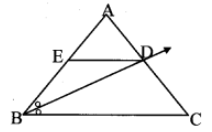
In $\triangle A B C$, ray $B D$ bisects $\angle A B C . A-D-C$, side $D E \|$ side $B C, A-E-B$, then prove that $\frac{A B}{B C}=\frac{A E}{E B}$
Image
In $\triangle A B C$, ray $B D$ bisects $\angle B$.
$\therefore \quad \frac{ AB }{ BC }=\frac{ AD }{ DC }$
In $\triangle ABC , DE \| BC$
$\therefore \quad \frac{ AE }{ EB }=\frac{ AD }{ DC }$
$\therefore \frac{ AB }{ ⬜ }=\frac{ ⬜ }{ EB }$
[Given]
[Angle biscetor theorem]
[Given]

[From (i) and (ii)]