MCQ
In determining the temperature of a distant star, one makes use of
  • A
    Kirchhoff's law
  • B
    Stefan's law
  • Wien's displacement law
  • D
    None of these

Answer

Correct option: C.
Wien's displacement law
c
(c)The temperature of stars can be determined by Wiens displacement law which is ${\lambda _m}.T = {\rm{constant}}{\rm{.}}$

Need a full question paper?

Generate a complete, print-ready paper with questions like this in minutes — across 16+ boards, with answer keys.
Start Generating Free

Similar questions

A breaker contains water up to a height $h_{1}$ and kerosene of height $h _{2}$ above water so that the total height of (water $+$ kerosene) is $\left( h _{1}+ h _{2}\right.$ ) Refractive index of water is $\mu_{1}$ and that of kerosene is $\mu_{2}$. The apparent shift in the position of the bottom of the breaker when viewed from above is
There is a long linear source of sound whose power is $P$ and length is $L$. At point$A$, sound level is $80$ $dB$ .Then at point $B$ sound level will be .... $dB$
A hydrogen atom (ionisation potential $ 13.6\, eV$) makes a transition from third excited state to first excited state. The energy of the photon emitted in the process is.......$eV$
The force between two charges $0.06\,m$ apart is $5\,N$. If each charge is moved towards the other by $0.01\,m$, then the force between them will become.........$N$
Red light of wavelength $5400$ $\mathring {A}$ from a distant source falls on a slit $0.80\, mm$ wide. Calculate the distance between first two dark bands on each side of central bright band in the diffraction pattern observed on a screen place $1.4\, m$ from the slit. (in $mm$)
Three copper rods are subjected to different potential difference. Compare the drift speed of electrons through them. Assume that all $3$ are at the same temperature.
  Length Diameter Potential difference
$(A)$ $L$ $3d$ $V$
$(B)$ $2L$ $d$ $2V$
$(C)$ $3L$ $2d$ $2V$
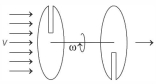
Two parallel discs are connected by a rigid rod of length $L=0.5 \,m$ centrally. Each disc has a slit oppositely placed as shown in the figure. A beam of neutral atoms are incident on one of the discs axially at different velocities $v$, while the system is rotated at angular speed of $600 \,rev / second$, so that atoms only with a specific velocity emerge at the other end. Calculate the two largest speeds (in metre/second) of the atoms that will emerge at the other end.
A galvanometer coil has a resistance $90\, \Omega$ and full scale deflection current $10\, mA$ . A $910\,\Omega$ resistance is connected in series with the galvanometer to make a voltmeter. If the least count of the voltmeter is $0.1\,V$, the number of divisions on its scale is
The electric field associated with an $e.m.$ wave in vacuum is given by $\vec E = \hat i\,40\,\cos \,\left( {kz - 6 \times {{10}^8}\,t} \right)$. where $E$, $z$ and $t$ are in $volt/m$, meter and seconds respectively. The value of wave factor $k$ is ....... $m^{-1}$.
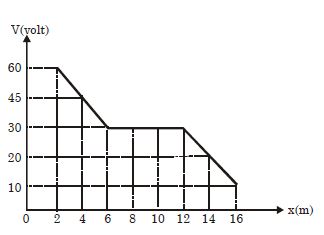
The variation of potential with distance $x$ from a fixed point is as shown in figure. The electric field at $x =13\,m$ is......$volt/meter$