A galvanometer coil has a resistance $90\, \Omega$ and full scale deflection current $10\, mA$ . A $910\,\Omega$ resistance is connected in series with the galvanometer to make a voltmeter. If the least count of the voltmeter is $0.1\,V$, the number of divisions on its scale is
Medium


Download our appand get started for free
Experience the future of education. Simply download our apps or reach out to us for more information. Let's shape the future of learning together!No signup needed.*
Similar Questions
- 1A uniform conducting wire of length $12 \mathrm{a}$ and resistance $'R'$ is wound up as a current carrying coil in the shape of,View Solution
$(i)$ an equilateral triangle of side $'a'.$
$(ii)$ a square of side $'a'.$
The magnetic dipole moments of the coil in each case respectively are:
- 2The magnetic field at the center of current carrying circular loop is $B _{1}$. The magnetic field at a distance of $\sqrt{3}$ times radius of the given circular loop from the center on its axis is $B_{2}$. The value of $B_{1} / B_{2}$ will be.View Solution
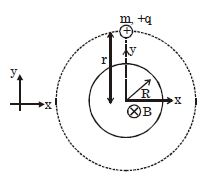
- 3Circular region of radius $R$ has uniform magnetic field $B = {B_0} + {B_0}t\left( { - \hat k} \right).\,At\,\,t\, = 0\,$ acceleration of charged particleView Solution
- 4A galvanometer having a coil resistance $100 \;\Omega$ gives a full scale deflection when a current of $1 \;\mathrm{mA}$ is passed through it. What is the value of the resistance which can convert this galvanometer into a voltmeter giving full scale deflection for a potential difference of $10\; \mathrm{V} ?$......$k\Omega$View Solution
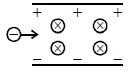
- 5An electron enters the space between the plates of a charged capacitor as shown. The charge density on the plate is $\sigma $. Electric intensity in the space between the plates is $E$. A uniform magnetic field $B$ also exists in that space perpendicular to the direction of $E$. The electron moves perpendicular to both $\vec E$ and $\vec B$ without any change in direction. The time taken by the electron to travel a distance $\ell $ is the space isView Solution
- 6A proton and a deutron both having the same kinetic energy, enter perpendicularly into a uniform magnetic field $B$. For motion of proton and deutron on circular path of radius ${R_p}$ and ${R_d}$ respectively, the correct statement isView Solution
- 7View SolutionIn a cyclotron, the angular frequency of a charged particle is independent of
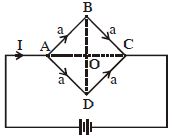
- 8Magnetic field at the centre $O$ of a square loop of side $'a'$ carrying current $I$ as shown in the figure isView Solution
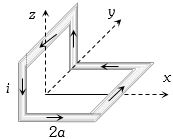
- 9A non-planar loop of conducting wire carrying a current $I$ is placed as shown in the figure. Each of the straight sections of the loop is of length $2a$. The magnetic field due to this loop at the point $P$ $(a,0,a)$ points in the directionView Solution
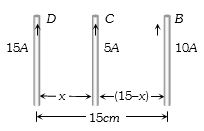
- 10Three long, straight and parallel wires carrying currents are arranged as shown in the figure. The wire $C$ which carries a current of $5.0\, amp$ is so placed that it experiences no force. The distance of wire $C$ from wire $D$ is thenView Solution