Question
In discussing Doppler effect, we use the word "apparent frequency". Does it mean that the frequency of the sound is still that of the source and it is some physiological phenomenon in the listener's ear that gives rise to Doppler effect? Think for the observer approaching the source and for the source approaching the observer.
Answer

In both cases if observer approaches source or source approaches observer the apparent frequency is physiological phenomenon as the frequency of the sound is still the same but due to motion w.r.t. each other the apparent frequency changes.

Need a full question paper?

Generate a complete, print-ready paper with questions like this in minutes — across 16+ boards, with answer keys.

Start Generating Free

Similar questions

At a hydroelectric power plant, the water pressure head is at a height of 300m and the water flow available is 100m3s–1. If the turbine generator efficiency is 60%, estimate the electric power available from the plant (g = 9.8ms–2).
While gas from a cooking gas cylinder is used, the pressure does not fall appreciably till the last few minutes. Why?
How much positive and negative charge is there in a cup of water?
Suppose you have three resistors of $20\Omega,50\Omega$ and $100\Omega.$ What minimum and maximum resistance can you obtain from these resistors?
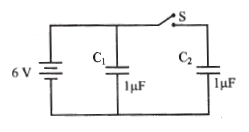
Figure shows two identical capacitors, C1 and C2, each of 1 μF capacitance connected to a battery of 6 V. Initially switch 'S' is closed. After sometime 'S' is left open and dielectric slabs of dielectric constant K = 3 are inserted to fill completely the space between the plates of the two capacitors. How will the (i) charge and (ii) potential difference between the plates of the capacitors be affected after the slabs are inserted?

Why are cells combined ? Also, how can the combination of cells be done?
Two point charges of $+10 \mu C$ and $-10 \mu C$ are kept at a distance of 40 cm from each other in air.(a) Calculate the electrical potential energy of the system. Assume that the electric potential energy at infinity is zero.(b) Draw the equipotential surface for the system.(c) How much work will have to be done to separateboth the charges of the system to infinity?
Find the average frictional force needed to stop a car weighing 500kg in a distance of 25m if the initial speed is 72km/ h.
What is called equipotential surface? Draw equipotential surfaces for point charges and write their properties.
A wheel is making revolutions about its axis with uniform angular acceleration. Starting from rest, it reaches 100rev/sec in 4 seconds. Find the angular acceleration. Find the angle rotated during these four seconds.