The separation between a node and the next antinode in a vibrating air column is 25cm. If the speed of sound in air is 340m/s, find the frequency of vibration of the air column.
Question types
Sound Waves question types
118 questions across 6 question groups — pick any mix to generate a Physics paper with step-by-step answer keys.
118
Questions
6
Question groups
5
Question types
01
2 Marks Questions
47 Q→023 Marks Question
20 Q→031 Marks Question
2 Q→044 Marks Questions
8 Q→05M.C.Q (1 Marks)
21 Q→065 Marks Questions
20 Q→Sample Questions
Sound Waves questions
One sample from each question group in this chapter. Select any group above to see the full set with answer keys.
View full solution →
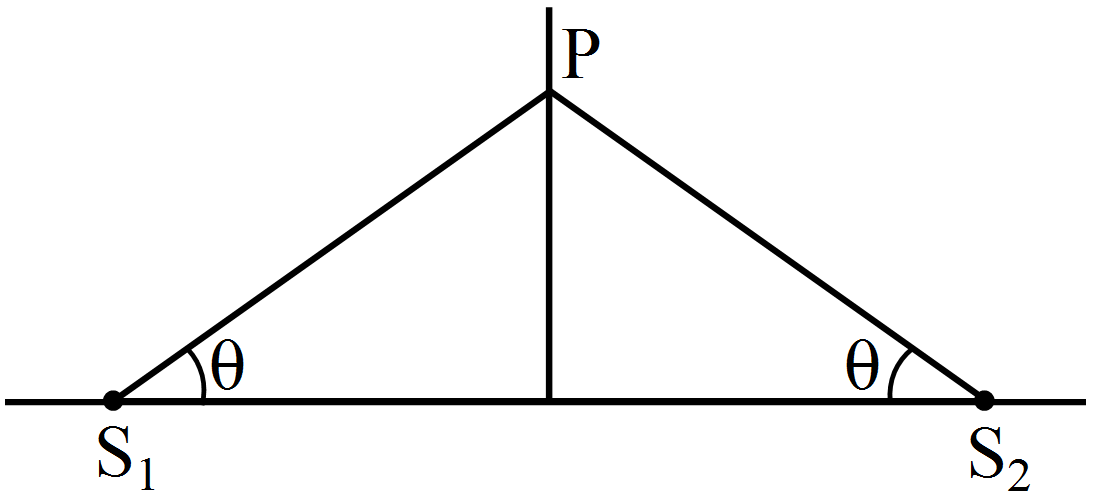
Two sources of sound S1 and S2 vibrate at same frequency and are in phase figure. The intensity of sound detected at a point P as shown in the figure is I0.
- If 0 equals 45°, what will be the intensity of sound detected at this point if one of the sources is switched off?
- What will be the answer of the previous part if = 60°?
If the sound level in a room is increased from 50dB to 60dB, by what factor is the pressure amplitude increased?
A small source of sound vibrating at frequency 500Hz is rotated in a circle of radius $\frac{100}{\pi}\text{cm}$ at a constant angular speed of 5.0 revolutions per second. A listener situates himself in the plane of the circle. Find the minimum and the maximum frequency of the sound observed. Speed of sound in air = 332m/s.
View full solution →At what temperature will the speed of sound be double of its value at 0°C?
Two sources of sound, S1 and S2, emitting waves of equal wavelength 20.0cm, are placed with a separation of 20.0cm between them. A detector can be moved on a line parallel to S1S2, and at a distance of 20.0cm from it. Initially, the detector is equidistant from the two sources. Assuming that the waves emitted by the sources are in phase, find the minimum distance through which the detector should be shifted to detect a minimum of sound.
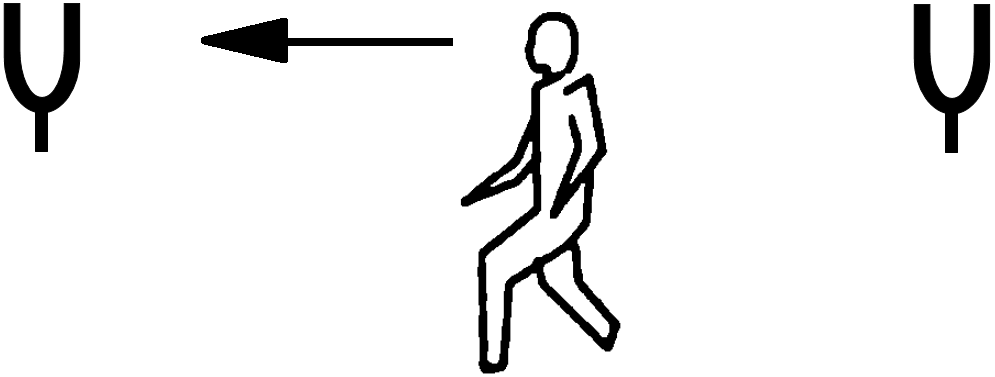
Two identical tuning forks vibrating at the same frequency 256Hz are kept fixed at some distance apart. A listener runs between the forks at a speed of 3.0m/s so that he approaches one tuning fork and recedes from the other figure. Find the beat frequency observed by the listener. Speed of sound in air = 332ms/s.
A person riding a car moving at 72km/h sounds a whistle emitting a wave of frequency 1250Hz. What frequency will be heard by another person standing on the road.
- In front of the car.
- Behind the car? Speed of sound in air = 340m/s.
A car moves with a speed of 54km/h towards a cliff. The horn of the car emits sound of frequency 400Hz at a speed of 3.35m/s.
- Find the wavelength of the sound emitted by the horn in front of the car.
- Find the wavelength of the wave reflected from the cliff.
- What frequency does a person sitting in the car hear for the reflected sound wave?
- How many beats does he hear in 10 seconds between the sound coming directly from the horn and that coming after the reflection?
In a Quincke's experiment, the sound intensity has a minimum value I at a particular position. As the sliding tube is pulled out by a distance of 16.5mm, the intensity increases to a maximum of 9I. Take the speed of sound in air to be 330m/s.
- Find the frequency of the sound source.
- Find the ratio of the amplitudes of the two waves arriving at the detector assuming that it does not change much between the positions of minimum intensity and maximum intensity.
If the intensity of sound is doubled, by how many decibels does the sound level increase?
A Kundt's tube apparatus has a copper rod of length 1.0m clamped at 25cm from one of the ends. The tube contains air in which the speed of sound is 340m/s. The powder collects in heaps separated by a distance of 5.0cm. Find the speed of sound waves in copper.
Two submarines are approaching each other in a calm sea. The first submarine travels at a speed of 36km/h and the other at 54km/h relative to the water. The first submarine sends a sound signal (sound waves in water are also called sonar) at a frequency of 2000Hz.
- At what frequency is this signal received by the second submarine?
- The signal is reflected from the second submarine. At what frequency is this signal received by the first submarine. Take the speed of the sound wave in water to be 1500m/s.
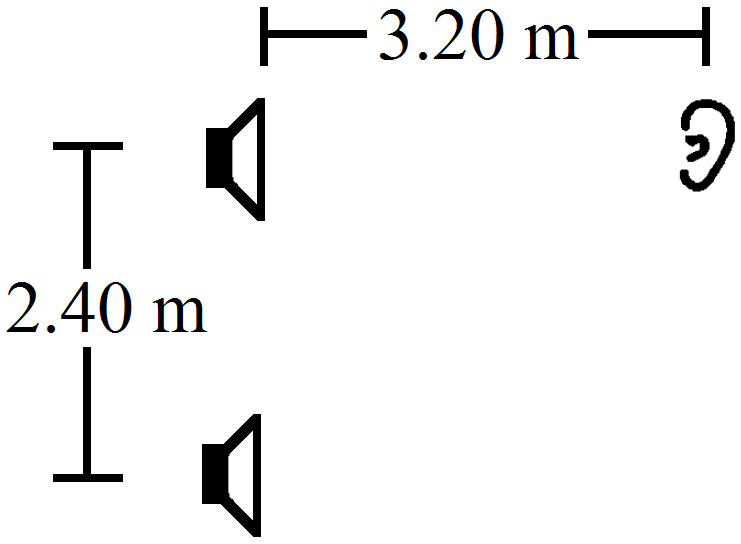
Two stereo speakers are separated by a distance of 2.40m. A person stands at a distance of 3.20m directly in front of one of the speakers as shown in figure, Find the frequencies in the audible range (20-2000Hz) for which the listener will hear a minimum sound intensity. Speed of sound in air = 320m/s.
The absolute temperature of air in a region linearly increases from T1 to T2 in a space of width d. Find the time taken by a sound wave to go through the region in terms of T1, T2, d and the speed v of sound at 273K. Evaluate this time for T1 = 280K, T2 = 310K, d = 33m and v = 330m/s.
If you are walking on the moon, can you hear the sound of stones cracking behind you? Can you hear the sound of your own footsteps?
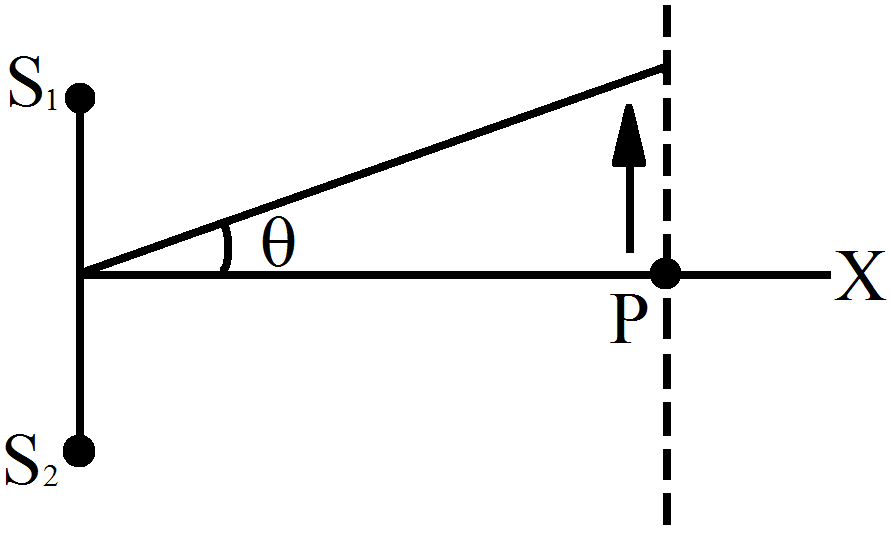
Two speakers S1 and S2, driven by the same amplifier, are placed at y = 1.0m and y = -1.0m figure, The speakers vibrate in phase at 600Hz. A man stands at a point on the X-axis at a very large distance from the origin and starts moving parallel to the Y-axis. The speed of sound in air is 330m/s.
View full solution →- At what angle $\theta$ will the intensity of sound drop to a minimum for the first time?
- At what angle will he hear a maximum of sound intensity for the first time?
- If he continues to walk along the line, how many more maxima can he hear?
A tuning fork of frequency 512Hz is vibrated with a sonometer wire and 6 beats per second are heard. The beat frequency reduces if the tension in the string is slightly increased. The original frequency of vibration of the string is:
- 506Hz
- 512Hz
- 518Hz
- 524Hz.
Consider the following statements about sound passing through a gas.
- The pressure of the gas at a point oscillates in time.
- The position of a small layer of the gas oscillates in time.
- Both A and B are correct.
- A is correct but B is wrong.
- B is correct but A is wrong.
- Both A and B are wrong.
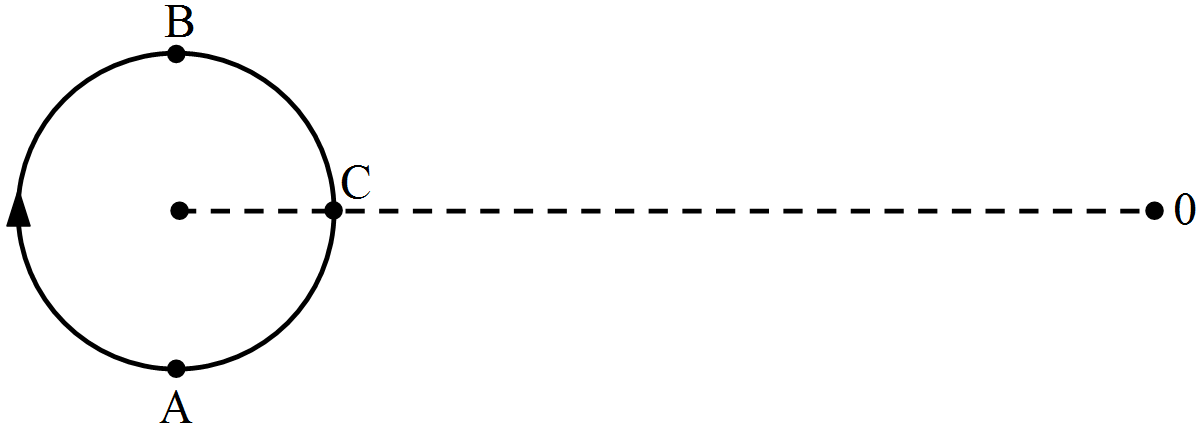
A small source of sound moves on a circle as shown-in figure and an observer is sitting at 0. Let v1, v2, v3 be the frequencies heard when the source is at A, B and C respectively.
- v1 > v2 > v3
- v1 = v2 > v3
- v2 > v3 > v1
- v1 > v2 > v2.
The speed of sound in a medium depends on:
- The elastic property but not on the inertia property.
- The inertia property but not on the elastic property.
- The elastic property as well as the inertia property.
- Neither the elastic property nor the inertia property.
Two sound waves move in the same direction in the same medium. The pressure amplitudes of the waves are equal but the wavelength of the first wave is double the second. Let the average power transmitted across a cross-section by the first wave be P1 and that by the 1 second wave be P2. Then,
- P1 = P2
- P1 = 4P2
- P2 = 2P1
- P2 = 4P1
A U-tube having unequal arm-lengths has water in it. A tuning fork of frequency 440Hz can set up the air in the shorter arm in its fundamental mode of vibration and the same tuning fork can set up the air in the longer arm in its first overtone vibration. Find the length of the air columns. Neglect any end effect and assume that the speed of sound in air = 330m/s.
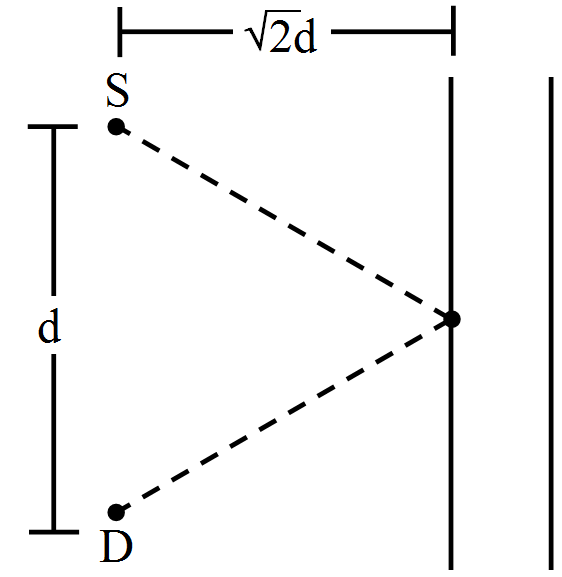
A source S and a detector D are placed at a distance d apart. A big cardboard is placed at a distance $\sqrt{2}\text{d}$ from the source and the detector as shown in figure, The source emits a wave of wavelength $=\frac{\text{d}}{2}$ which is received by the detector after reflection from the cardboard. It is found to be in phase with the direct wave received from the source. By what minimum distance should the cardboard be shifted away so that the reflected wave becomes out of phase with the direct wave?
View full solution →A tuning fork of unknown frequency makes 5 beats per second with another tuning fork which can cause a closed organ pipe of length 40cm to vibrate in its fundamental mode. The beat frequency decreases when the first tuning fork is slightly loaded with wax. Find its original frequency. The speed of sound in air is 320m/s.
Two audio speakers are kept some distance apart and are driven by the same amplifier system. A person is sitting at a place 6.0m from one of the speakers and 6.4m from the other. If the sound signal is continuously varied from 500Hz to 5000Hz, what are the frequencies for which there is a destructive interference at the place of the listener? Speed of sound in air = 320m/s.
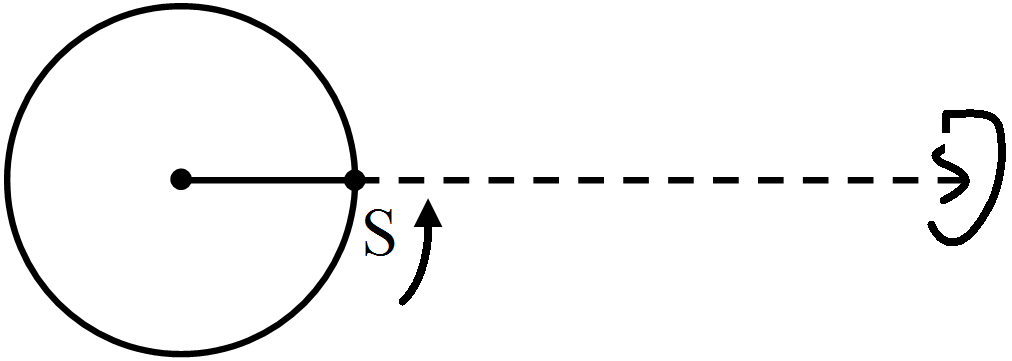
A small source of sound S of frequency 500Hz is attached to the end of a light string and is whirled in a vertical circle of radius 1.6m. The string just remains tight wher the source is at the highest point.
- An observer is located in the same vertical plane at a large distance and at the same height as the centre of the circle figure. The speed of sound in air = 330m/s and g = 10m/s 2. Find the maximum frequency heard by the observer.
- An observer is situated at a large distance vertically above the centre of the circle. Find the frequencies heard by the observer corresponding to the sound emitted by the source when it is at the same height as the centre.
Generate a Sound Waves paper free
Pick question groups from the list above, set marks and difficulty, and export a branded PDF with step-by-step answer keys. First 3 chapters free — no signup.