Question
In discussing Doppler effect, we use the word "apparent frequency". Does it mean that the frequency of the sound is still that of the source and it is some physiological phenomenon in the listener's ear that gives rise to Doppler effect? Think for the observer approaching the source and for the source approaching the observer.
Answer

In both cases if observer approaches source or source approaches observer the apparent frequency is physiological phenomenon as the frequency of the sound is still the same but due to motion w.r.t. each other the apparent frequency changes.

Need a full question paper?

Generate a complete, print-ready paper with questions like this in minutes — across 16+ boards, with answer keys.

Start Generating Free

Similar questions

Give the location of the centre of mass of a:
  1. Sphere.
  2. Cylinder.
  3. Ring, and
  4. Cube, each of uniform mass density.
Does the centre of mass of a body necessarily lie inside the body?
Explain why:
The earth without its atmosphere would be inhospitably cold.
1 cubic cm of gas at NTP. Find the number of molecules in the volume.
A steel rod of length 1m rests on a smooth horizontal base. If it is heated from 0°C to 100°C, what is the longitudinal strain developed?
Two bar magnets are placed close to each other with their opposite poles facing each other. In absence of other force the magnets are pulled towards each other and their kinetic energy increases. Does it contradict our earher knowledge that magnetic forces cannot do any work and hence cannot increase kinetic energy of a system?
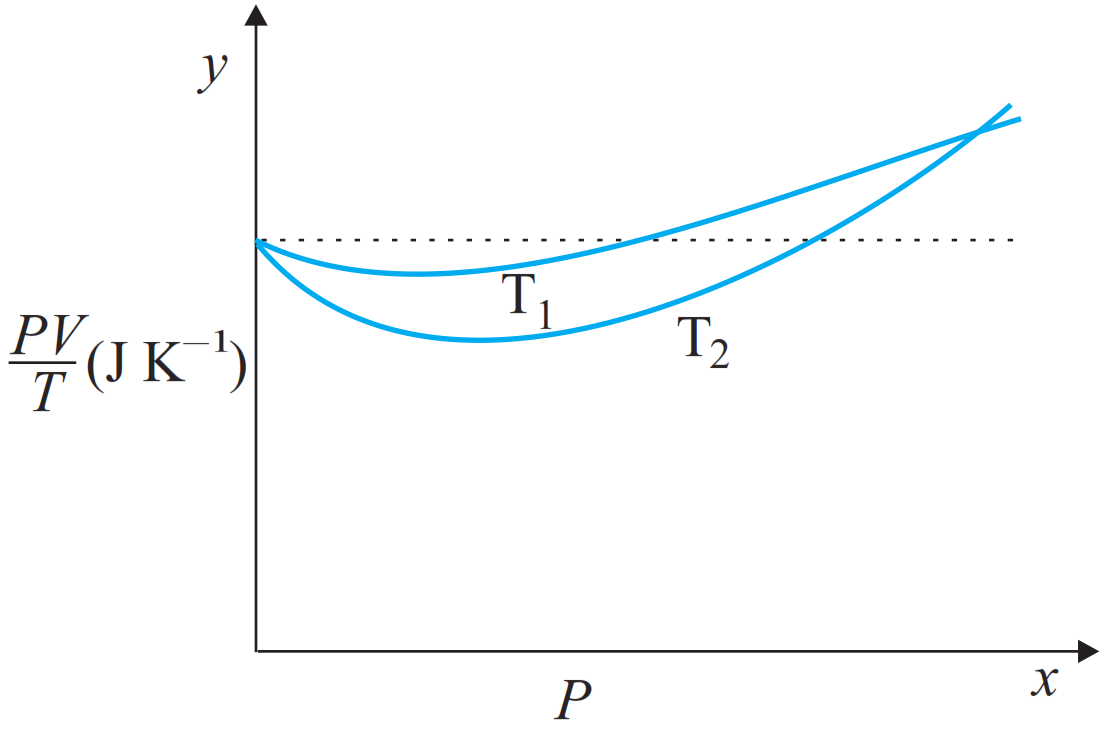
Shows plot of $\frac{\text{PV}}{\text{T}}$ versus P for 1.00 × 10⁻³kg of oxygen gas at two different temperatures.
What does the dotted plot signify?

A particle is moving in a straight line. Is it possible for it to maintain the motion in the same direction while the acceleration is in the reverse direction?
Find the greatest length of an organ pipe open at both ends that will have its fundamental frequency in the normal hearing range (20Hz-20,000Hz). Speed of sound in air = 340m/s.
An extended object is placed at a distance of 5.0cm from a convex lens of focal length 8.0cm.
  1. Draw the ray diagram (to the scale) to locate the image and from this, measure the distance of the image from the lens.
  2. Find the position of the image from the lens formula and see how close the drawing is to the correct result.
What is mean free path of a gas molecule? On which factors does the mean free path depend?