MCQ
In double slit experiment, the wavelength $\lambda $ of the light source $400\ nm$ , the slit seperation $d$ is $20\ \mu m$ and the individual slit width a is $4\ \mu m$ . Consider the interference of the light from the two slits and also the diffraction of light through each slit. Find number bright interference fringes are within the central peak of diffraction envelope
  • A
    $3$
  • B
    $6$
  • C
    $7$
  • $9$

Answer

Correct option: D.
$9$
d
$\mathrm{d} \sin \theta=\mathrm{n} \lambda$ for interference

$\mathrm{d} \sin \theta=\lambda$ for diffraction

$\frac{d}{a}=n=\frac{20}{4}=5$

so interference maximas is in $9$

Need a full question paper?

Generate a complete, print-ready paper with questions like this in minutes — across 16+ boards, with answer keys.

Start Generating Free

Similar questions

A particle is executing simple harmonic motion with an amplitude of $0.02$ metre and frequency $50\, Hz$. The maximum acceleration of the particle is
A wire of length $314\,cm$ carrying current of $14\,A$ is bent to form a circle. The magnetic moment of the coil is $........A- m ^{2}$. [Given $\left.\pi=3.14\right]$
A wheel is rotating at $900\, r.p.m.$ about its axis. When the power is cut-off, it comes to  rest in $1\,minute$ . The angular retardation in $radian/s^2$ is:-
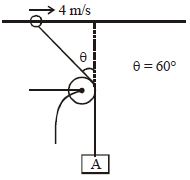
For the given fig. find the speed of block $A$ when $\theta  = {60^o}$
The ratio of average translational kinetic energy to rotational kinetic energy of a diatomic molecule at temperature $T$ is
A submarine has a window of area $30 \times 30 \,cm ^2$ on its ceiling and is at a depth of $100 \,m$ below sea level in a sea. If the pressure inside the submarine is maintained at the sea-level atmosphere pressure, then the force acting on the window is ............. $N$ (consider density of sea water $=1.03 \times 10^3 \,kg / m ^3$, acceleration due to gravity $=10 \,m / s ^2$ )
The work done to raise a mass $\mathrm{m}$ from the surface of the earth to a height $\mathrm{h}$, which is equal to the radius of the earth, is 
A parallel plate capacitor of capacitance $C$ is connected to a battery and is charged to a potential difference $V$. Another capacitor of capacitance $2C$ is connected to another battery and is charged to potential difference $2V$. The charging batteries are now disconnected and the capacitors are connected in parallel to each other in such a way that the positive terminal of one is connected to the negative terminal of the other. The final energy of the configuration is
A wire of length $L$ and cross-sectional area $A$ is made of a material of Young's modulus $Y.$ It is stretched by an amount $x$. The work done is
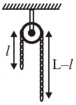
A uniform metal chain of mass $m$ and length ' $L$ ' passes over a massless and frictionless pulley. It is released from rest with a part of its length ' $l$ ' is hanging on one side and rest of its length ' $L -l$ ' is hanging on the other side of the pulley. At a certain point of time, when $l=\frac{L}{x}$, the acceleration of the chain is $\frac{g}{2}$. The value of $x$ is ........