MCQ
In equilibrium, the total energy is equally distributed in all possible energy modes having an energy equal to $\text{1/2KB T,}$ this is called as:
  • A
    Boyle’s law
  • B
    Charle’s law
  • Law of equipartition of energy
  • D
    None

Answer

Correct option: C.
Law of equipartition of energy

Need a full question paper?

Generate a complete, print-ready paper with questions like this in minutes — across 16+ boards, with answer keys.

Start Generating Free

Similar questions

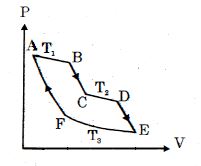
One mole of ideal gas taken through a cycle process with alternate isothermal and adiabatic curves. In $P-V$ diagram $AB, CD, EF$ are isothermal curves at the absolute temperature $T_1, T_2$ and $T_3$ respectively and $BC, DE$ and $FA$ are adiabatic curves respectively. If $\frac{{{V_B}}}{{{V_A}}} = 2,\,\frac{{{V_D}}}{{{V_C}}} = 2$ then for cycle is shown in figure four statements are being made given below. (Figure is not drawn on scale) 

Statement $1$ : Ratio of volumes $\frac{{{V_E}}}{{{V_F}}} = 4$

Statement $2$ : Magnitude of work done in isothermal compression $EF$ is $2RT_3\ ln\ (2)$

Statement $3$ : Ratio of heat supplied to gas in the process $AB$ to heat rejected by gas in process $EF$ is $\frac{{{T_1}}}{{2{T_3}}}$

Statement $4$ : Net work done by gas in the cycle $ABCDEFA$ is $(T_1 + T_2 - 2T_3) R\  ln\ (2)$ 

Find the number of correct statement $(s)$ given for the cyclic process followed by gas
The bulk modulus of a gas is defined as $B=-V d p / d V$. For an adiabatic process the variation of $B$ is proportional to $p^n$. For an ideal gas $n$ is
Four particles given, have same momentum which has maximum kinetic energy
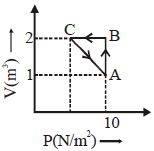
An ideal gas is taken through the cycle $A \to B \to C \to A,$ as shown in the figure. What is the change in internal energy ...... $J$.
A substance breaks down by a stress of $10^6 N/m^2$. If the density of the material of the wire is $3×10^3 kg/m^3$, then the length of the wire of the substance which will break under its own weight when suspended vertically, is ......... $m$
A billiard ball moving with a speed of $5 \,m/s$ collides with an identical ball originally at rest. If the first ball stops after collision, then the second ball will move forward with a speed of ...........  $m{s^{ - 1}}$
If the length of rod $A$ is $3.25 \pm 0.01 \,cm$ and that of $B$ is $4.19 \pm 0.01\, cm $ then the rod $B$ is longer than rod $A$ by
The total kinetic energy of $1$ mole of oxygen at $27^{\circ} \mathrm{C}$ is :

[Use universal gas constant $(R)=8.31 \mathrm{~J} / \mathrm{mole} \mathrm{K}$ ]
For $z=a^{2} x^{3} y^{\frac{1}{2}}$, where $a$ is a constant. If percentage error in measurement of $x$ and $y$ are $4 \%$ and $12 \%$, respectively, then the percentage error for $z$ will be $%$
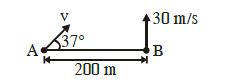
Two particles $A$ and $B$ are moving in horizontal plane as shown in figure at $t = 0$ , then time after which $A$ will catch $B$ will be.......$s$