MCQ
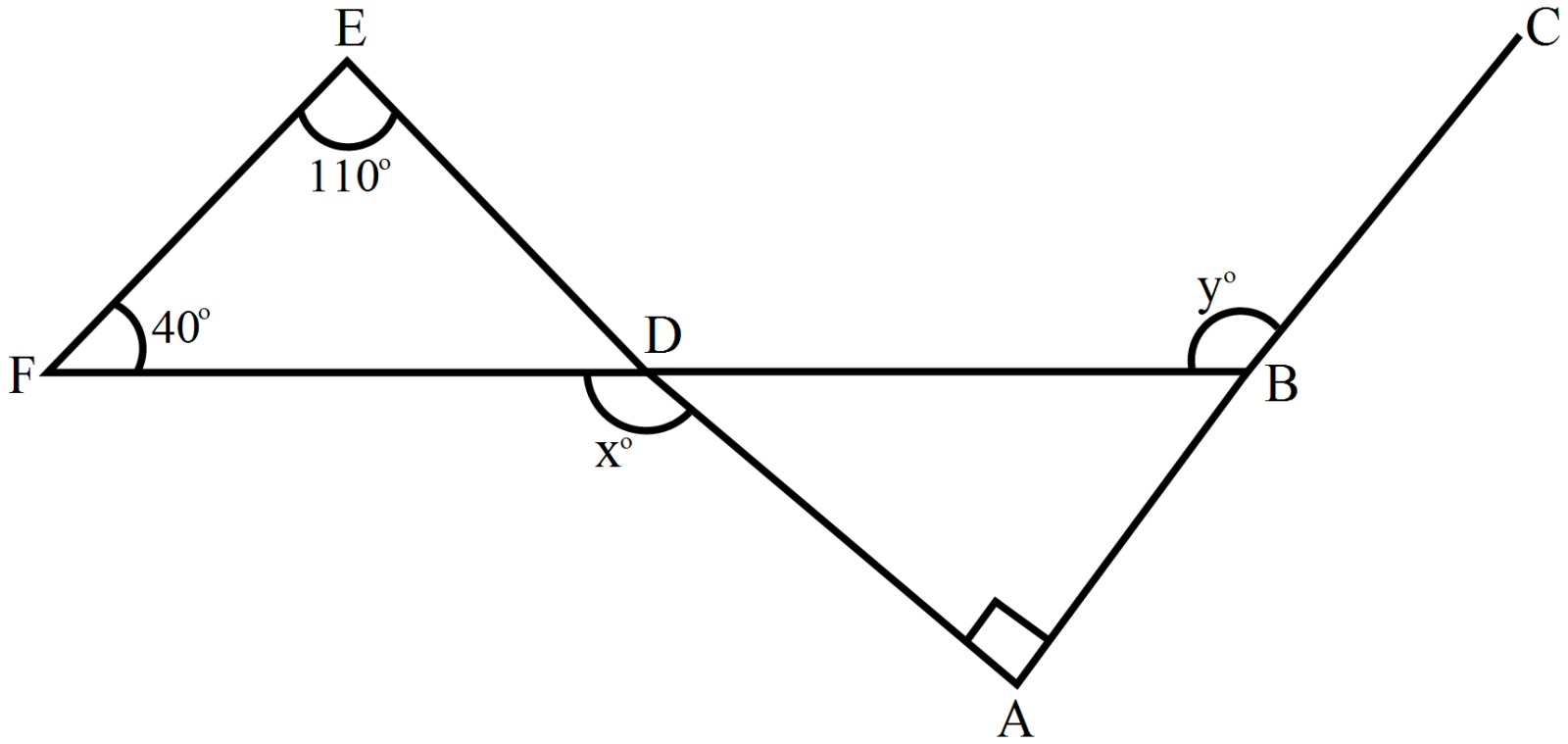
In Fig. the values of $x$ and $y$ are:
- A$x = 120, y = 150$
- B$x = 110, y = 160$
- ✓$x = 150, y = 120$
- D$x = 110, y = 160$
In $\triangle \text{DEF}$
$\angle \text{DEF}+\angle \text{DFE}+\angle \text{EDF}=180^\circ$ [Angle sum property of triangle]
$\Rightarrow 110^\circ+40^\circ+\angle \text{EDF}=180^\circ$
$\Rightarrow \angle \text{EDF}=30^\circ$
Now, $\angle \text{EDF}+\angle \text{FDA}=180^\circ$ [Linear pair angles]
$\Rightarrow 30^\circ+\text{x}^\circ=180^\circ$
$\Rightarrow \text{x}=150$
Now, $\angle \text{EDF}=\angle \text{ADB}=30^\circ$ [Vertically opposite angles]
Now, In $\triangle \text{ABD},$
$\angle \text{ADB}+\angle \text{DAB}+\angle \text{ABD}=180^\circ$ [Angle sum property of triangle]
$\Rightarrow 30^\circ+90^\circ+\angle \text{ABD}=180^\circ$
$\Rightarrow \angle \text{ABD}=60^\circ$
Now, $\angle \text{ABD}+\angle \text{DBC}=180^\circ$ [Linear pair angles]
$\Rightarrow 60^\circ+\text{y}^\circ=180^\circ$
$\Rightarrow \text{y}=120$
Hence, the correct answer is option $(c).$
Generate a complete, print-ready paper with questions like this in minutes — across 16+ boards, with answer keys.