Question
In Figure ABCD is a regular hexagon, which vectors are:
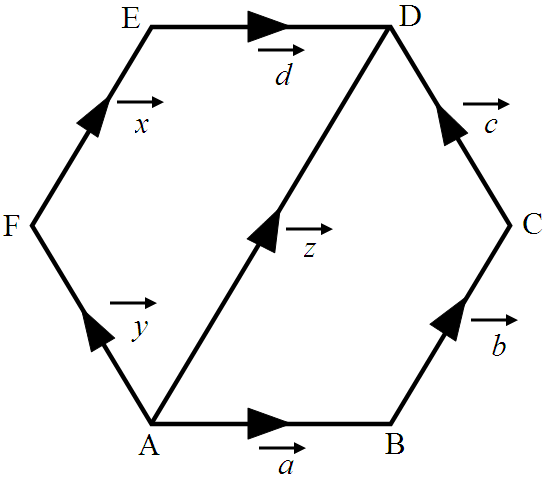
  1. Collinear.
  2. Equal.
  3. Co-initial.
  4. Collinear but not equal.

Answer

  1. Vectors having the same or parallel supports are called collinear vector. In the given figure the collinear vectors are,
$\vec{\text{a}},\ \vec{\text{d}};\ \vec{\text{x}},\ \vec{\text{z}},\ \vec{\text{b}};\ \vec{\text{c}},\ \vec{\text{y}}$
  1. vectors having the same magnitude and direction are called equal vector. In the given figure the equal vectors are,
$\vec{\text{b}},\ \vec{\text{x}};\ \vec{\text{c}},\ \vec{\text{y}};\ \vec{\text{a}},\ \vec{\text{d}}$
  1. Vectors having the same initial point are called co-initial vector. In the given figure the co-initial vectors are,
$\vec{\text{a}},\ \vec{\text{y}},\ \vec{\text{z}}$
  1. The vectors which are collinear but not equal are $\vec{\text{b}},\ \vec{\text{z}};\ \vec{\text{x}},\ \vec{\text{z}}$

Need a full question paper?

Generate a complete, print-ready paper with questions like this in minutes — across 16+ boards, with answer keys.

Start Generating Free

Similar questions

Given the probability that A can solve a problem is $\frac{2}{3}$ and the probability that B can solve the same problem is $\frac{3}{5}$. Find the probability that none of the two will be able to solve the problem.
Find the maximum and minimum value of 2x + y subject to the constraints:

$\text{x}+3\text{y}\geq6,\text{x}-3\text{y}\leq3,3\text{x}+4\text{y}\leq24,$ $-3\text{x}+2\text{y}\leq6,5\text{x}+\text{y}\geq5,\text{x},\text{y}\geq0$
Show that in any triangle $ABC a = b \cos C + c \cos B$
Differentiate the following functions with respect to x:
$\sin(\text{x}^\text{x})$
Using properties of determinants, show that $\triangle\text{ABC}$ is isosceles if:
$\begin{vmatrix} 1 & 1 & 1 \\ 1 + \cos\text{A} & 1 + \cos\text{B} & 1 + \cos\text{C} \\ \cos^{2}\text{A} + \cos\text{A} & \cos^{2}\text{B}+\cos\text{B} & \cos^{2}\text{C} + \cos\text{C} \end{vmatrix} = 0 $
Evaluate the following integrals:
$\int\frac{(\text{x}\tan^{-1}\text{x})}{(1+\text{x}^2)^{\frac{3}{2}}}\text{dx}$
If $\text{y}\sqrt{\text{x}^2+1}=\log\Big(\sqrt{\text{x}^2+1}-\text{x}\Big),$ prove that $\big(\text{x}^2+1\big)\frac{\text{dx}}{\text{dx}}+\text{xy}+1=0$
Show that the function $f : R \rightarrow R$ defined by $f(x)=\frac{x}{x^2+1}, \forall x \in R$ is neither one$-$one nor onto.
Kellogg is a new cereal formed of a mixture of bran and rice that contains at least 88 grams of protein and at least 36 milligrams of iron. Knowing that bran contains 80 grams of protein and 40 milligrams of iron per kilogram, and that rice contains 100 grams of protein and 30 milligrams of iron per kilogram, find the minimum cost of producing this new cereal if bran costs Rs. 5 per kg and rice costs Rs 4 per kg.
Evaluate the following integrals:
$\int\limits_{0}^{\text{a}}\sqrt{\text{a}^2-\text{x}^2}\text{ dx}$