Question
✓
Answer
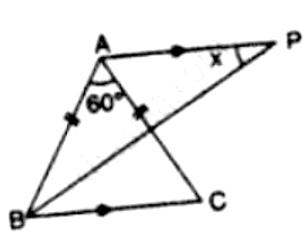
In the figure,
$A B=A C$ and $B P$ bisects $\angle A B C$
$A P \| B C$ is drawn.
Now $\angle \mathrm{PBC}=\angle \mathrm{PBA}$ ( $\because P B$ is the bisector of $\angle A B C$ )
$\because A P \| B C$
$\therefore \angle \mathrm{APB}=\angle \mathrm{PBC}$ ....... (Alternate angles)
$ \Rightarrow x=\angle \mathrm{PBC} $
In $\triangle \mathrm{ABC}, \angle \mathrm{A}=60^{\circ}$
and $\angle B=\angle C$. $\ldots(\because A B=A C)$
But $\angle A+\angle B+\angle C=180^{\circ}$......... (Angles of a triangle)
$\Rightarrow 60^{\circ}+\angle B+\angle C=180^{\circ}$
$\Rightarrow 60^{\circ}+\angle B+\angle B=180^{\circ}$
$\Rightarrow 2 \angle \mathrm{B}=180^{\circ}-60^{\circ}=120^{\circ}$
$\therefore \angle B=\frac{120^{\circ}}{2}=60^{\circ}$
$\Rightarrow \frac{1}{2} \angle \mathrm{B}=\frac{60^{\circ}}{2}=30^{\circ}$
$\Rightarrow \angle \mathrm{PBC}=30^{\circ}$
$\therefore$ From (i),
$ x=30^{\circ} $
$A B=A C$ and $B P$ bisects $\angle A B C$
$A P \| B C$ is drawn.
Now $\angle \mathrm{PBC}=\angle \mathrm{PBA}$ ( $\because P B$ is the bisector of $\angle A B C$ )
$\because A P \| B C$
$\therefore \angle \mathrm{APB}=\angle \mathrm{PBC}$ ....... (Alternate angles)
$ \Rightarrow x=\angle \mathrm{PBC} $
In $\triangle \mathrm{ABC}, \angle \mathrm{A}=60^{\circ}$
and $\angle B=\angle C$. $\ldots(\because A B=A C)$
But $\angle A+\angle B+\angle C=180^{\circ}$......... (Angles of a triangle)
$\Rightarrow 60^{\circ}+\angle B+\angle C=180^{\circ}$
$\Rightarrow 60^{\circ}+\angle B+\angle B=180^{\circ}$
$\Rightarrow 2 \angle \mathrm{B}=180^{\circ}-60^{\circ}=120^{\circ}$
$\therefore \angle B=\frac{120^{\circ}}{2}=60^{\circ}$
$\Rightarrow \frac{1}{2} \angle \mathrm{B}=\frac{60^{\circ}}{2}=30^{\circ}$
$\Rightarrow \angle \mathrm{PBC}=30^{\circ}$
$\therefore$ From (i),
$ x=30^{\circ} $
Need a full question paper?
Generate a complete, print-ready paper with questions like this in minutes — across 16+ boards, with answer keys.
Explore more
Similar questions
Three persons start a business and spend Rs. 25,000; Rs. 15,000 atid Rs. 40,000 respectively. Find the share of each out of a profit of Rs. 14,400 in a year
Find the S.I. and amount on: Rs. 850 from 10th March to 3rd August at $2 \frac{1}{2} \%$ p.a.
→Kumar bought a transistor for Rs. 960. He paid 12 % cash money. The rest he agreed to pay in 12 equal monthly instalments. How much will he pay each month?
From each corner of a rectangular paper (30 cm x 20 cm) a quadrant of a circle of radius 7 cm is cut. Find the area of the remaining paper i.e., shaded portion. 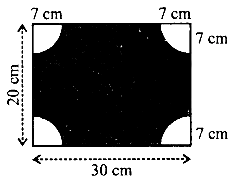
The ratio between the radius of two circles is $5 : 7$ Find the ratio between their:
$(i)$ circumference
$(ii)$ areas
→$(i)$ circumference
$(ii)$ areas
A bus is moving with a speed of $65 \frac{1}{2} \mathrm{~km}$ per hour. How much distance will it cover in $1 \frac{1}{3}$ hours.
→In the case, given below, draw a line through point $P$ and parallel to $A B:$
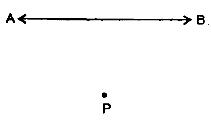
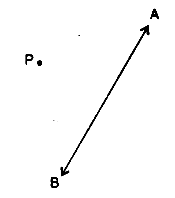
→In the case, given below, draw a line through point $P$ and parallel to $A B:$
→Express the ratio in simplest form : $2 \frac{1}{3}: 3 \frac{1}{4}: 1 \frac{1}{6}$
→$27-[13+\{4-(8+4-\overline{1+3}\}]$
→