Question
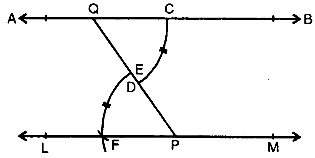
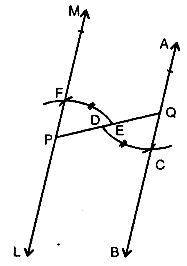
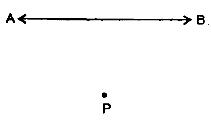
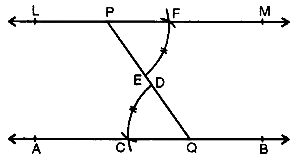
In the case, given below, draw a line through point $P$ and parallel to $A B:$

Answer

Steps of construction:
(i) From P draw a line segment meeting at $A B$
(ii) With centre $Q$ and some suitable radius draw an arc $C D$.
(iii) With centre $P$ and the same radius draw another arc meeting $P Q$ at $E$.

(iv) With centre $E$ and radius equal to $C D$, cut this arc at $F$

(v) Join PF and produce it to both sides to $L$ and $M$. Then line $L M$ is parallel to given line $A B$.

Need a full question paper?

Generate a complete, print-ready paper with questions like this in minutes — across 16+ boards, with answer keys.
Start Generating Free

Similar questions

If 32 apples weigh 2 kg 800 g. How many apples will there be in a box, containing 35 kg of apples?
Evaluate: $3 \frac{5}{12}+1 \frac{2}{3}$
A boy spent $\frac{3}{5}$ of his money on buying 1 cloth and $\frac{1}{4}$ of the remaining on buying shoes. If initially, he has ₹ 2400 ; how much did he spend on shoes?
Solve: x – 30% of x = 35
Evaluate: $\frac{-9}{4}+\frac{13}{3}+\frac{25}{6}$
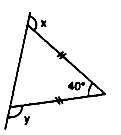
Apply the properties of isosceles and equilateral triangles to find the unknown angles in the given figure:
Shyam bought a refrigerator for Rs. 5000 . He paid $\frac{1}{10}$ of the price in cash and the rest in 12 equal monthly instalments. How much had he to pay each month?
Following data shows the weekly wages (in ₹) of 10 workers in a factory.
3500, 4250, 4000, 4250, 4000, 3750, 4750, 4000, 4250 and 4000
(i) Prepare a frequency distribution table.
(ii) What is the range of wages (in ₹)?
(iii) How many workers are getting maximum wages?
Amar is an electrician. He bought $7 \frac{1}{2}$ bundles of an electric cable where each bundle had $202 \frac{4}{5} m$ of cable.
Q.1. Find the total length of the cable purchased by Amar.
(a) 1427 m  (b) 1521 m  (c) 1605 m  (d) 1717 m
Q.2. If the cost of cable is ₹$ 6 \frac{2}{3}$ per metre, find the amount paid by Amar.
(a) ₹ 8830    (b) ₹ 9520  (c) ₹ 10140  (d) ₹ 11280
Q.3. Amarused $2 \frac{1}{2}$ bundles of cable for electric connections in the top floor of the building. What length of cable was used for the top floor?
(a) 476 m   (b) 507 m   (c) 625 m   (d) 712 m
Q.4. Amar cut a length of $13 \frac{4}{5} m$ from a bundle and divided the remaining cable of this bundle into pieces of 21 m, length each. How many pieces of 21 m did he get from this bundle?
(a) 9   (b) 10   (c) 11   (d) 12
A computer purchased for ₹ 72900 loses two-third of its value every year. Its value is evaluated at the end of every year.
Q.1. Which of the following expressions gives the value of the computer (in ₹) after n years?
(a) $\frac{72900}{\left(\frac{2}{3}\right)^n}$ $\quad$$\quad$(b) $\frac{2^n \times 27900}{3^n}$ $\quad$$\quad$(c) $\frac{72900}{3^n}$ $\quad$$\quad$ (d) $\frac{72900}{2^n \times 3^n}$
Q.2. Find the value of the computer after 3 years.
(a) ₹ 8100 $\quad$$\quad$(b) ₹ 2430 $\quad$$\quad$(c) ₹ 5600$\quad$$\quad$ (d) ₹ 2700
Q.3. In how many years will the value of the computer be less than ₹ 200?
(a) 6 years $\quad$$\quad$(b) 7 years $\quad$$\quad$(c) 8 years $\quad$$\quad$(d) 10 years
Q.4. By how much will the value of the computer reduce in 4 years?
(a) ₹ 24300 $\quad$$\quad$(b) ₹ 1800 $\quad$$\quad$(c) ₹ 8100 $\quad$$\quad$(d) ₹ 72000