Question
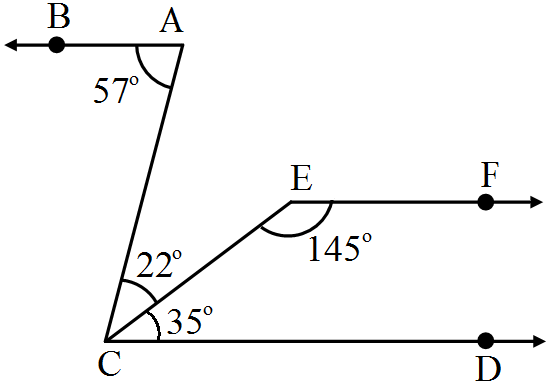
In figure, show that AB || EF.

Answer

Produce EF to intersect AC at K. Now,$\angle\text{DCE}+\angle\text{CEF}=35+145=180^\circ$
Therefore, EF || CD ... (1) [Since Sum of Co-interior angles is 180] Now,$\angle\text{BAC}=\angle\text{ACD}=57^\circ$
⇒ BA || EF ... (2) [Alternative angles are equal] From (1) and (2) AB || EF [Since, Lines parallel to the same line are parallel to each other] Hence proved.

Need a full question paper?

Generate a complete, print-ready paper with questions like this in minutes — across 16+ boards, with answer keys.
Start Generating Free

Similar questions

Prove that the straight lines perpendicular to the same straight line are parallel to one another.
If the radius and slant height of a cone are in the ratio $7: 13$ and its curved surface area is $286 cm^2$, find its radius.
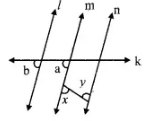
In the given figure, if ∠a ≅ ∠b and ∠x ≅ ∠y, then prove that line l | line n.

Image
Given: ∠a ≅ ∠b and ∠x ≅ ∠y
To prove: line l | line n

i. Can we draw a line parallel to the Y – axis at a distance of 2 units from ¡t and to its right?
ii. Will all of the points (2, 10), (2, 8), (2, -) be on that line?
iii. What would be the equation of this line?
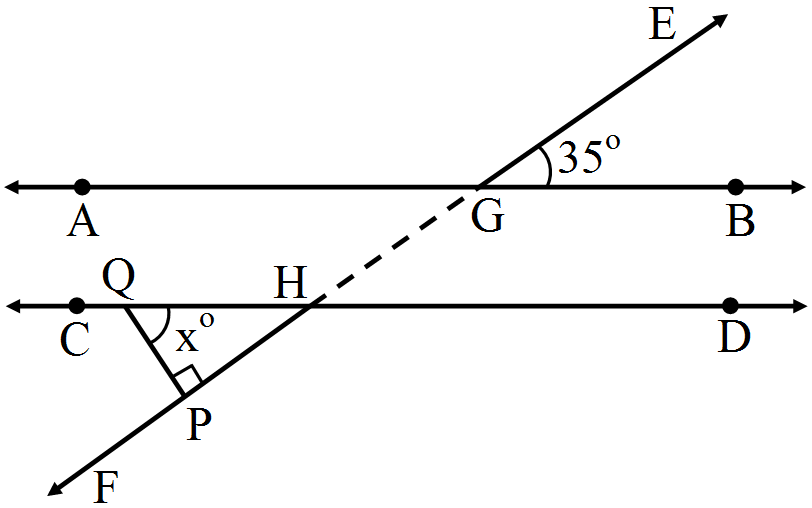
In the given figure, AB || CD and EF is a transversal, cutting them at G and H respectively. If $\angle\text{EGB}=35^\circ$ and $\text{QP}\perp\text{EF},$ find the measure of $\angle\text{PQH}.$
Prove that:$\Big(\frac{1}{\text{x}^{\text{a}-\text{b}}}\Big)^{\frac{1}{\text{a}-\text{c}}}\times\Big(\frac{1}{\text{x}^{\text{b}-\text{c}}}\Big)^{\frac{1}{\text{b}-\text{a}}}\times\Big(\frac{1}{\text{x}^{\text{c}-\text{a}}}\Big)^{\frac{1}{\text{c}-\text{b}}}=1$
A field is $200m$ long and $150m$ broad. There is a plot, $50m$ long and $40m$ broad, near the field. The plot is dug $7m$ deep and the earth taken out is spread evenly on the field. By how many meters is the level of the field raised? Give the answer to the second place of decimal.
If $\frac{x}{3 x-y-z}=\frac{y}{3 y-z-x}=\frac{z}{3 z-x-y}$ and $x + y + z \neq 0$, then show that the value of each ratio is equal to 1.
Compare the following : $\frac{\sqrt{80}}{\sqrt{48}}, \frac{\sqrt{45}}{\sqrt{27}}$
How many pairs of adjacent angles are formed when two lines intersect in a point?