MCQ
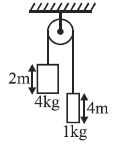
In figure shown, both blocks are released from rest. Find the time to cross each other ? ......... $\sec$
  • $1$
  • B
    $\sqrt 2$
  • C
    $2$
  • D
    $\frac{1}{{\sqrt 2 }}$

Answer

Correct option: A.
$1$
a
From $F B D$ of blocks $A$ and $B$ solve acceleration of each block $4 g-T=4 a \ldots(1)$

$T-1 g=1 \times a \ldots(2)$

After solving eqns $(1)$ and $(2) a=\frac{3 g}{5}$ acceleration of $\mathrm{A}$ wr.t $B a_{A / B}=\frac{6 g}{5}=12 \mathrm{m} / \mathrm{s}^{2}$

If $A$ will cross $B$ then distance travelled by $A$ $w.r.t$ $B$ is $6 m$

$6=0+\frac{1}{2} \times 12 \times t^{2}, t=1 \mathrm{sec}$

Need a full question paper?

Generate a complete, print-ready paper with questions like this in minutes — across 16+ boards, with answer keys.
Start Generating Free

Similar questions

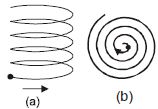
A particle is going with constant speed along a uniform helical and spiral path separately as shown in figure
A charged particle moves in a uniform magnetic field. The velocity of the particle at some instant makes an acute angle with the magnetic field. The path of the particle will be:
  1. A straight line.
  2. A circle.
  3. A helix with uniform pitch.
  4. A helix with nonuniform pitch.
An ice block is melting at a constant rate $\left| {\,\frac{{dm}}{{dt}}\,} \right|= \mu$ . Its initial mass is $m_0$ and it is moving with velocity on a frictionless horizontal surface. The distance travelled by it till it melts completely is :
Correct pair is ..........
A man is carrying a block of a certain substance (of density $1000 \,kg{m^{ - 3}}$) weighing $1 \,kg$ in his left hand and a bucket filled with water and weighing $10 \,kg$ in his right hand. He drops the block into the bucket. How much load does he carry in his right hand now  ........... $kg$
A copper and a steel wire of the same diameter are connected end to end. A deforming force F is applied to this composite wire which causes a total elongation of 1cm. The two wires will have
  1. The same stress.
  2. Different stress.
  3. The same strain.
  4. Different strain.
The absolute temperature of a gas is determined by
A particle $P$ is moving in a circle of radius $'a'$ with a uniform speed $v$. $C$ is the centre of the circle and $AB$ is a diameter. When passing through $B$ the angular velocity of $P$ about $A$ and $C$ are in the ratio
Which of the following is not an assumption for an ideal fluid flow for which Bernoulli's principle is valid
At constant pressure how much fraction of heat supplied to gas is converted into mechanical work?