MCQ
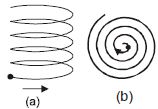
A particle is going with constant speed along a uniform helical and spiral path separately as shown in figure
  • A
    The velocity of the particle is constant in both cases
  • B
    The magnitude of acceleration of the particle is constant in both cases
  • The magnitude of accleration is constant in $(a)$ and decreasing in $(b)$
  • D
    The magnitude of accleration is decreasing continuously in both the cases
Answer

Correct option: C.
The magnitude of accleration is constant in $(a)$ and decreasing in $(b)$
c
${a_c}\, = \,\frac{{{v^2}}}{r},$ radius is constant in case $(a)$ and increase in case $(b).$ So that magnitude of acceleration is constant in case $(a)$ and decrease in case $(b).$

Need a full question paper?

Generate a complete, print-ready paper with questions like this in minutes — across 16+ boards, with answer keys.

Start Generating Free

Similar questions

A plank with a box on it at one end is gradually raised about the other end. As the angle of inclination with the horizontal reaches $30^o$, the box starts to slip and slides $4.0\, m$ down the plank in $4.0\,s$. The coefficients of static and kinetic friction between the box and the plank will be, respectively
Two satellite $A$ and $B$ go round a planet in circular orbits having radii $4 R$ and $R$ respectively. If the speed of $\mathrm{A}$ is $3 v$, the speed of $\mathrm{B}$ will be :
$Assertion$ : A balloon filled with hydrogen will fall with acceleration $\frac{g}{6}$ of the moon

$Reason$ : Moon has no atmosphere.

A cyclic process $ABCA$ is shown in the $V-T $ diagram. Process on the $P-V$ diagram is
$P-V$ diagram of a diatomic gas is a straight line passing through origin. The molar heat capacity of the gas in the process will be
A steel rod of length 1m and radius 10mm is stretched by a force 100kN along its length. The stress produced in the rod is Ysteel = 2 × 10¹¹Nm-2.
The equation of motion of a projectile is $y = Ax -Bx^2$ where $A$ and $B$ are the constants of motion. The horizontal range of the projectile is
A particle is performing simple harmonic motion with amplitude A and angular velocity ${\omega }$. The ratio of maximum velocity to maximum acceleration is
Two points are located at a distance of $10\; m$ and $15 \;m$ from the source of oscillation. The period of oscillation is $0.05 \;sec$ and the velocity of the wave is $300 \;m / s$. What is the phase difference between the oscillations of two points?
A wheel of radius 20cm is pushed to move it on a rough horizontal surface. It is found to move through a distance of 60cm on they road during the time it completes one revolution about the centre. Assume that the linear and the angular accelerations are uniform. The frictional force acting on the wheel by the surface is:
  1. Along the velocity of the wheel.
  2. Opposite to the velocity of the wheel.
  3. Perpendicular to the velocity of the wheel.
  4. Zero.