MCQ
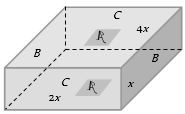
In figure shows a rectangular block with dimensions $x,\, 2x$ and $4x$. Electrical contacts can be made to the block between opposite pairs of faces (for example, between the faces labelled $A-A, B-B$ and $C-C$). Between which two faces would the maximum electrical resistance be obtained ($A-A$ : Top and bottom faces, $B-B$ : Left and right faces, $C-C$ : Front and rear faces)
  • A
    $A-A$
  • B
    $B-B$
  • $C-C$
  • D
    Same for all three pairs

Answer

Correct option: C.
$C-C$
c
Let $\rho $ is the resistivity of the material

Resistance for contact $A-A$

${R_{AA}} = \rho \frac{x}{{2x \times 4x}} = \frac{\rho }{{8x}}$

Similar for contacts $B-B$ and $C-C$ are respectively

${R_{BB}} = \rho .\frac{{2x}}{{x \times 4x}} = \frac{\rho }{{2x}} = \frac{{4\rho }}{{8x}}$
and ${R_{CC}} = \rho \frac{{4x}}{{x \times 2x}} = \frac{{2\rho }}{x} = \frac{{16\rho }}{{8x}}$

It is clear maximum resistance will be for contact $C-C$.

Need a full question paper?

Generate a complete, print-ready paper with questions like this in minutes — across 16+ boards, with answer keys.

Start Generating Free