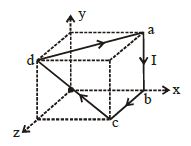
In figure the cube is of $40\,\, cm$ edge. Four straight segment of wire $ab, bc, cd$ and $da$ form a closed loop that carries a current $I = 5\,A$. A uniform magnetic field $0.02\,\,T$ is in $+y\,-$ direction ratio of magnetic force on segement $ab$ and $bc$ is
Medium


Download our appand get started for free
Experience the future of education. Simply download our apps or reach out to us for more information. Let's shape the future of learning together!No signup needed.*
Similar Questions
- 1A proton (or charged particle) moving with velocity $v$ is acted upon by electric field $E$ and magnetic field $B$. The proton will move undeflected ifView Solution
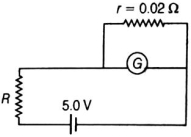
- 2In the circuit, shown the galvanometer $G$ of resistance $60\, \Omega$ is shunted by a resistance $r=0.02\, \Omega$. The current through $R$ (in $ohm$) is nearly $1\, A$. The value of resistance $R$ (in $ohm$) is nearly (in $\Omega$)View Solution
- 3In a moving coil galvanometer, the deflection of the coil $\theta $ is related to the electrical current $i$ by the relationView Solution
- 4View SolutionIf the direction of the initial velocity of the charged particle is perpendicular to the magnetic field, then the orbit will be or The path executed by a charged particle whose motion is perpendicular to magnetic field is
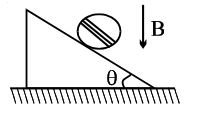
- 5In the figure shown a coil of single turn is wound on a sphere of radius $R$ and mass $m.$ The plane of the coil is parallel to the plane and lies in the equatorial plane of the sphere. Current in the coil is $i$. The value of $B$ if the sphere is in equilibrium isView Solution
- 6The resistance of a galvanometer is $50\, ohm$ and the maximum current which can be passed through it is $0.002\, A$. What resistance must be connected to it in order to convert it into an ammeter of range $0 -0.5\, A$ ?....$ohm$View Solution
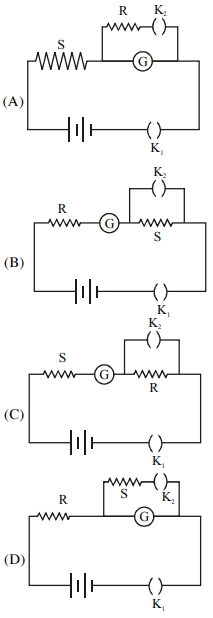
- 7In the circuit diagrams $(A, B, C$ and $D$) shown below, $R$ is a high resistance and $S$ is a resistance of the order of galvanometer resistance $G$. The correct circuit, corresponding to the half deflection method for finding the resistance and figure of merit of the galvanometer, is the circuit labelled asView Solution
- 8A galvanometer, whose resistance is $50\,ohm,$ has $25$ divisions in it. When a current of $4\times 10^{-4}\,A$ passes through it, its needle (pointer) deflects by one division. To use this galvanometer as a voltmeter of range $2.5\,V,$ it should be connected to a resistance of.......$ohm$View Solution
- 9A particle of mass $m$ and charge $q$ is thrown from origin at $t = 0$ with velocity $2\hat{i}$ + $3\hat{j}$ + $4\hat{k}$ units in a region with uniform magnetic field $\vec B$ = $2\hat{i}$ units. After time $t =\frac{{\pi m}}{{qB}}$ , an electric field is switched on such that particle moves on a straight line with constant speed. $\vec E$ may beView Solution
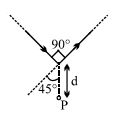
- 10Find the magnetic field at $P$ due to the arrangement shownView Solution