Question
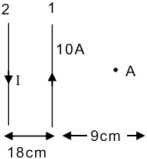
In figure two parallel infinitely long current carrying wires are shown. If resultant magnetic field at point $A$ is zero. Then determine current $I.$ (in $A$)
Answer

Consider the following figure

At point $A$

$B _{1}= B _{2}$

$\frac{\mu_{0} i _{1}}{2 \pi r _{1}}=\frac{\mu_{0} i _{2}}{2 \pi r _{2}}$

$\frac{ i _{1}}{29}=\frac{10}{9}$

$i _{1}=30 A$

Need a full question paper?

Generate a complete, print-ready paper with questions like this in minutes — across 16+ boards, with answer keys.
Start Generating Free

Similar questions

The resistance of a wire is $5\,ohm$  at $50\,^o C$ and $6\,ohm $ at $100\,^o C$. The resistance of the wire at $0\,^o C$ will be .............. $\Omega$
A star is moving away from the earth with a velocity of $100 km/s$. If the velocity of light is $3 \times {10^8}m/s$ then the shift of its spectral line of wavelength $5700 Å$ due to Doppler's effect will be.....$\mathop A\limits^o $
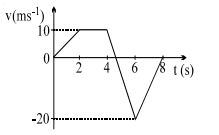
The figure shows a velocity-time graph of a particle moving along a straight line  Identify the region in which the rate of change of velocity $\left| {\frac{{\Delta \vec v}}{{\Delta t}}} \right|$ of the particle is maximum
Two forces of magnitude $P$ & $Q$ acting at a point have resultant $R$. The resolved  part of $R$ in the direction of $P$ is of magnitude $Q$. Angle between the forces is :
A shell of mass $200\, gm$ is ejected from a gun of  mass $4\, kg$ by an explosion that generates $1.05\, kJ$ of energy. The initial velocity of the shell is .............. $\mathrm{ms}^{-1}$
If a capillary tube is dipped into liquid and the levels of the liquid inside and outside are same, then the angle of contact is ...... $^o$
Which of the following formulae is wrong
A man in a lift throws up a ball, with velocity v m/s relative to the lift and catches it after t sec. The vertical acceleration of the lift is:
Consider two masses with $m_1 > m_2$ connected by a light inextensible string that passes over a pulley of radius $R$ and moment of inertia $I$ about its axis of rotation. The string does not slip on the pulley and  the pulley turns without friction. The two masses are released from rest separated by a vertical distance $2 h$. When the two masses pass each other, the speed of the masses is proportional to
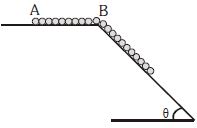
$A$ chain of length $L$ and mass $m$ is placed upon a smooth surface. The length of $BA$ is $L-b$. Calculate the velocity of the chain when its end reaches $B$.