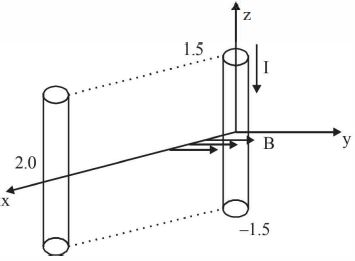
A conductor lies along the $z-$axis $a$ $-1.5$$ \le Z < 1.5\,m$ carries a fixed current of $10.0\ A$ in $ - {\hat a_z}$ direction (see figure). For a field $\vec B$ $=$ $3.0 \times 10^{-4}$ $e^{-0.2x}$ ${\hat a_y}\,T$ find the power required to move the conductor at constant speed to $x = 2.0\ m, y = 0\ m$ in $5 \times 10^{-3}\ s$. Assume parallel motion along the $x-$axis........$ W$
JEE MAIN 2014, Diffcult
Download our app for free and get started
Work done in moving the conductor is,
$W=\int_{0}^{2} F d x$
$=\int_{0}^{2} 3.0 \times 10^{-4} e^{-0.2 x} \times 10 \times 3 d x$
$=9 \times 10^{-3} \int_{0}^{2} e^{-0.2 x} d x$
$=\frac{9 \times 10^{-3}}{0.2}\left[-e^{-0.2 \times 2}+1\right] B=3.0 \times 10^{-4} e^{-0.2 x}$
(By exponential function)
$=\frac{9 \times 10^{-3}}{0.2} \times\left[1-e^{-0.4}\right]$
$=9 \times 10^{-3} \times(0.33)=2.97 \times 10^{-3}\, \mathrm{J}$
Power required to move the conductor is, $P=\frac{W}{t}$
$P=\frac{2.97 \times 10^{-3}}{(0.2) \times 5 \times 10^{-3}}=2.97 \,\mathrm{W}$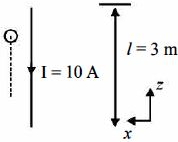

Download our appand get started for free
Experience the future of education. Simply download our apps or reach out to us for more information. Let's shape the future of learning together!No signup needed.*
Similar Questions
- 1An infinitely long wire, located on the $z$-axis, carries a current $/$ along the $+z$-direction and produces the magnetic field $\vec{B}$. The magnitude of the line integral $\int \vec{B} \cdot d l$ along a straight line from the point $(-\sqrt{3} a, a, 0)$ to $(a, a, 0)$ is given by [ $\mu_0$ is the magnetic permeability of free space.]View Solution
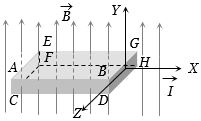
- 2A metallic block carrying current $I$ is subjected to a uniform magnetic induction $\overrightarrow B $ as shown in the figure. The moving charges experience a force $\overrightarrow F $ given by ........... which results in the lowering of the potential of the face ........ Assume the speed of the carriers to be $v$View Solution
- 3Given below are two statements$:$View Solution
Statement $I:$ Biot-Savart's law gives us the expression for the magnetic field strength of an infinitesimal current element (IdI) of a current carrying conductor only.
Statement $II :$ Biot-Savart's law is analogous to Coulomb's inverse square law of charge $q$, with the former being related to the field produced by a scalar source, Idl while the latter being produced by a vector source, $q$. In light of above statements choose the most appropriate answer from the options given below:
- 4If the maximum value of accelerating potential provided by a ratio frequency oscillator is $12\, {kV}$. The number of revolution made by a proton in a cyclotron to achieve one sixth of the speed of light is ....... .View Solution
$\left[{m}_{{p}}=1.67 \times 10^{-27} {kg}, {e}=1.6 \times 10^{-19} {C},\right.$ Speed of light $\left.=3 \times 10^{8} {m} / {s}\right]$
- 5A voltmeter has a resistance of $G\, ohms$ and range $V\, volts$. The value of resistance used in series to convert it into a voltmeter of range $nV$ $volts$ isView Solution
- 6An $\alpha - $ particle travels in a circular path of radius $0.45\, m$ in a magnetic field $B = 1.2\,Wb/{m^2}$ with a speed of $2.6 \times {10^7}\,m/\sec $. The period of revolution of the $\alpha - $ particle isView Solution
- 7The current in the windings of a toroid is $2.0\,A$. There are $400\,turns$ and the mean circumferential length is $40\,cm$. If the inside magnetic field is $1.0\,T,$ the relative permeability is near toView Solution
- 8A small square loop of wire of side $l$ is placed inside a large square loop of wire of side $L(L >> l)$. The loops are coplaner and their centres coincide. The mutual inductance of the system is propotional toView Solution
- 9A metallic rod of mass per unit length $0.5\; kg\; m^{-1}$ is lying horizontally on a smooth inclined plane which makes an angle of $30^o$ with the horizontal. The rod is not allowed to slide down by flowing a current through it when a magnetic field of induction $0.25\; T$ is acting on it in the vertical direction. The current flowing in the rod to keep it stationary is.....$A$View Solution
- 10A current of $1.5\, {A}$ is flowing through a triangle, of side $9\, {cm}$ each. The magnetic field at the centroid of the triangle isView Solution
(Assume that the current is flowing in the clockwise direction.)