MCQ
In forced oscillations, a particle oscillates simple harmonically with a frequency equal to
  • Frequency of driving force
  • B
    Natural frequency of body
  • C
    Difference of frequency of driving force and patural frequency
  • D
    Mean of frequency of driving force and patural frequency
Answer

Correct option: A.
Frequency of driving force
a
(a)

In forced oscillations a particle oscillator simple harmonically with a frequency equal to driving frequency.

Need a full question paper?

Generate a complete, print-ready paper with questions like this in minutes — across 16+ boards, with answer keys.

Start Generating Free

Similar questions

$A$ man of mass $M$ stands at one end of a plank of length $L$ which lies at rest on a frictionless surface. The man walks to other end of the plank. If the mass of the plank is $\frac{M}{3}$ , then the distance that the man moves  relative to ground is :
If the pressure in a closed vessel is reduced by drawing out some gas, the mean free path of the molecules
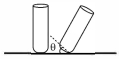
Figure below shows a shampoo bottle in a perfect cylindrical shape. In a simple experiment, the stability of the bottle filled with different amount of shampoo volume is observed. The bottle is tilted from one side and then released. Let the angle $\theta$ depicts the critical angular displacement resulting, in the bottle losing its stability and tipping over. Choose the graph correctly depicting the fraction $f$ of shampoo filled $(f=1$ corresponds to completely filled) versus the tipping angle $\theta$
When a wave travels in a medium, the particle displacements are given by $y = a\, sin\, 2\pi\, (bt -cx)$ where $a, b,$ and $c$ are constants. The maximum particle velocity will be twice the wave velocity if
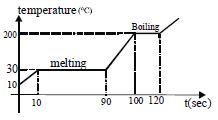
A given mass $m$ of a hypothetical solid is supplied with heat continuously at a constant rate and the graph shown in the adjacent figure is plotted. If $L_f$ and $L_v$ are latent heats of fusion and latent heats of vaporization and $S_l$ and $S_s$ are specific heats of liquid and solid respectively. It can be concluded that 
Two particles are in $SHM$ in a straight line. Amplitude $A$ and time period $T$ of both the particles are equal. At time $t=0,$ one particle is at displacement $y_1= +A$ and the other at $y_2= -A/2,$ and they are approaching towards each other. After what time they cross each other ?
The temperature inside and outside a refrigerator are $273 \,K$ and $300 \,K$ respectively. Assuming that the refrigerator cycle is reversible, for every joule of work done, the heat delivered to the surrounding will be nearly ........ $J$
An electric dipole is placed in an electric field generated by a point charge.
  1. The net electric force on the dipole must be zero.
  2. The net electric force on the dipole may be zero.
  3. The torque on the dipole due to the field must be zero.
  4. The torque on the dipole due to the field may be zero.
For an adiabatic expansion of an ideal gas, the fractional change in its pressure is equal to (where $\gamma$ is the ratio of specific heats):
A fluid is flowing through a horizontal pipe of varying cross-section, with speed $v\;ms^{-1}$ at a point where the pressure is $P$ Pascal. At another point where pressure is $\frac{ P }{2}$ Pascal its speed is $V\;ms^{-1}$. If the density of the fluid is $\rho\, kg\, m ^{-3}$ and the flow is streamline, then $V$ is equal to