MCQ
In gamma ray emission from a nucleus
  • there is no change in the proton number and the neutron number
  • B
    only the neutron number changes
  • C
    only the proton number changes
  • D
    both the neutron number and the proton number change

Answer

Correct option: A.
there is no change in the proton number and the neutron number
a
There is no change in the proton number and the neutron number as the $\gamma$ -emission takes place as a result of excitation or de-excitation of nuclei. $\gamma$ -rays have no charge or mass.

Need a full question paper?

Generate a complete, print-ready paper with questions like this in minutes — across 16+ boards, with answer keys.
Start Generating Free

Similar questions

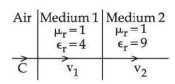
As shown in the figure, after passing through the medium $1$. The speed of light $v _{2}$ in medium $2$ will be$.....\times 10^{8}\,ms ^{-1}$  $\left(\text { Given } c =3 \times 10^{8} ms ^{-1}\right)$
The masses and radii of the earth and moon are ${M_1},\,{R_1}$ and ${M_2},\,{R_2}$ respectively. Their centres are distance d apart. The minimum velocity with which a particle of mass $m$ should be projected from a point midway between their centres so that it escapes to infinity is
The change in a vector may occur due to .....
A source producing sound of frequency $170 Hz$ is approaching a stationary observer with a velocity $17 \,ms^{-1}$. The apparent change in the wavelength of sound heard by the observer is (speed of sound in air $= 340 \,ms^{-1}$)  ..... $m$
A particle is dropped vertically from rest from a height. The time taken by it to fall through successive distances of $1\, m$ each will then be
In Young's double slit experiment, one of the slit is wider than other, so that amplitude of the light from one slit is double of that from other slit. If $I_m$ be the maximum intensity, the resultant intensity $I$ when they interfere at phase difference $\phi$ is given by
Convergence of concave mirror can be decreased by dipping in
Choose the correct statement(s) for hydrogen and deuterium atoms (considering motion of nucleus)
A black hole is an object whose gravitational field is so strong that even light cannot escape from it. To what approximate radius would earth $($ mass $= 5 .98 \times \,10^{24}\, kg)$ have to be compressed to be a black hole?