Question
In $\gamma\ \text{ray}$ emission from a nucleus:

Answer

  1. There is no change in the proton number and the neutron number.

Need a full question paper?

Generate a complete, print-ready paper with questions like this in minutes — across 16+ boards, with answer keys.
Start Generating Free

Similar questions

The field normal to the plane of a wire of $n$ turns and radius $r$ which carries a current $i$ is measured on the axis of the coil at a small distance $h$ from the centre of the coil. This is smaller than the field at the centre by the fraction
Photo cells are used for the(a) Reproduction of pictures from the cinema film(b) Reproduction of sound from the cinema film(c) Automatic switching of street light(d) (b) and (c) both


Which of the following materials is non crystalline(a) Copper(b) Sodium chloride(c) Wood (d) Diamond
       
One of the specialties of nuclear reactions is that in their disintegrated or fused part :
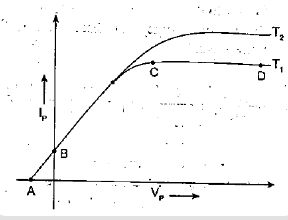
A graph of vacuum diode current $I_p​,$ is plotted against the anode voltage $V_p​$ for two different temperatures $T_{1​}$ and $T_{2​}$ of the cathode, as shown in the figure below. Study the graph and answer the following questions.
For the same anode voltage$, ($called plate voltage$),$ the current more when the cathode temperature changes from $T_1​$ to $T_2$​ higher temperature.
What is shape of magnet in moving coil galvanometer to make the radial magnetic field(a) Concave(b) Horse shoe magnet(c) Convex(d) None of these
       
A circular coil of $500$ turns of wire has an enclosed area of $0.1 \mathrm{~m}^2$ per turn. It is kept perpendicular to a magnetic field of induction $0.2 T$ and rotated by $180^\circ $ about a diameter perpendicular to the field in $0.1 \sec.$ How much charge will pass when the coil is connected to a galvanometer with a combined resistance of $50$ ohms
Equal potentials are applied on an iron and copper wire of same length. In order to have the same current flow in the two wires, the ratio $r\ ($iron$)\ / r\ ($copper$)$ of their radii must be $($Given that specific resistance of iron $=1.0 \times 10^{-7}$ ohm$-m$ and specific resistance of copper $=1.7 \times 10^{-8}$ ohm$-m)$
The heavier nuclei tend to have larger $\frac{\text{N}}{\text{Z}}$ ratio because:
  1. A neutron is heavier than a proton.
  2. A neutron is an unstable particle.
  3. A neutron does not exert electric repulsion.
  4. Coulomb forces have longer range compared to the nuclear forces.
The distance between the two charges 25μC and 36μC is 11 cm At what point on the line joining the two, the intensity will be zero(a) At a distance of 5 cm from 25 μC (b) At a distance of 5 cm from 36 μC (c) At a distance of 10 cm from 25 μC (d) At a distance of 11 cm from 36 μC