MCQ
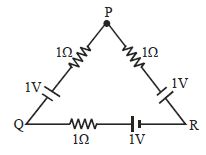
In given circuit find potential difference between $P$ and $Q$ .................. $V$
  • $0$
  • B
    $1$
  • C
    $2$
  • D
    $\frac{2}{3}$

Answer

Correct option: A.
$0$
a
$\mathrm{I}=\frac{3}{3}=1 \mathrm{\,A},$ from kirchoff's rule

$\mathrm{V}_{\mathrm{P}}+1-1=\mathrm{V}_{\mathrm{Q}}$

$\mathrm{V}_{\mathrm{P}}-\mathrm{V}_{\mathrm{Q}}=0$

Need a full question paper?

Generate a complete, print-ready paper with questions like this in minutes — across 16+ boards, with answer keys.

Start Generating Free

Similar questions

A beam of light of $\lambda = 600 \,\,nm$ from a distant source falls on a single slit $1\,\, mm$ wide and the resulting diffraction pattern is observed on a screen $2\,\, m$ away. The distance between first dark fringes on either side of the central bright fringe is 
Three concentric spherical shells have radii $a, b$ and $c (a < b < c)$ and have surface charge densities $\sigma ,-\;\sigma $ and $\;\sigma \;$ respectively. If  $V_A,V_B$ and $V_C$  denote the potentials of the three shells, then, for $c = a +b,$ we have
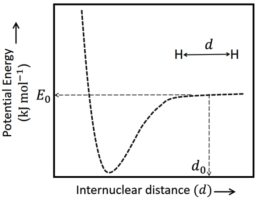
The figure below is the plot of potential energy versus internuclear distance $(d)$ of $H _2$ molecule in the electronic ground state. What is the value of the net potential energy $E_0$ (as indicated in the figure) in $kJ mol ^{-1}$, for $d=d_0$ at which the electron-electron repulsion and the nucleus-nucleus repulsion energies are absent? As reference, the potential energy of $H$ atom is taken as zero when its electron and the nucleus are infinitely far apart.

Use Avogadro constant as $6.023 \times 10^{23} mol ^{-1}$.
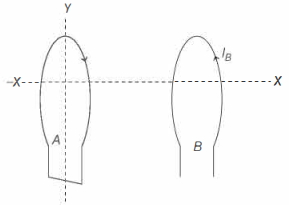
The diagram below shows two circular loops of wire ( $A$ and $B$ ) centred on and perpendicular to the $X$-axis and oriented with their planes parallel to each other. The $Y$-axis passes vertically through loop $A$ (dashed line). There is a current $I_B$ in loop $B$ as shown in the diagram. Possible actions which we might perform on loop $A$ are

$(I)$ move $A$ to the right along $X$-axis closer to $B$

$(II)$ move $A$ to the left along $X$-axis away from $B$

$(III)$ as viewed from above, rotate $A$ clockwise about $Y$-axis

$(IV)$ as viewed from above, rotate $A$ anti-clockwise about $Y$-axis

Which of the actions will induce a current in $A$ only in the direction shown?
An electric charge $10^{-6} \mu \mathrm{C}$ is placed at origin $(0,0)$ $\mathrm{m}$ of $\mathrm{X}-\mathrm{Y}$ co-ordinate system. Two points $\mathrm{P}$ and $\mathrm{Q}$ are situated at $(\sqrt{3}, \sqrt{3}) \mathrm{m}$ and $(\sqrt{6}, 0) \mathrm{m}$ respectively. The potential difference between the points $P$ and $Q$ will be :
A Zener diode :
A scientist claims to have a perfect technique in which he can spontaneously convert an electron completely into energy in the laboratory without any other material required. What is the conclusion about this claim from our current understanding of physics?
According to Ohm's law, relation between current density $j$ and intensity of electric field $E$ is :
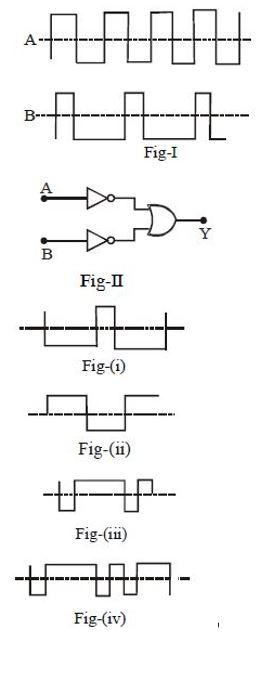
Input waveforms $A$ and $B$ as shown in fig $I$ are applied to the combination of gates as shown in Fig.$II$. Which of the waveforms shown in Fig. $(i)$ to $(iv)$ correctly represents the output waveform?
The coil of dynamo is rotating in a magnetic field. The developed induced e.m.f. changes and the number of magnetic lines of force also changes. Which of the following condition is correct