MCQ
In given force - time graph, area encloses by graph on time axis gives:
  • Impulse
  • B
    force
  • C
    Energy
  • D
    Velocity

Answer

Correct option: A.
Impulse
(A) Impulse,
Impulse $=$ force $\times$ time

Need a full question paper?

Generate a complete, print-ready paper with questions like this in minutes — across 16+ boards, with answer keys.
Start Generating Free

Similar questions

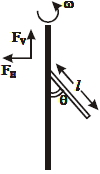
A uniform rod of length $'l'$ is pivoted at one of its ends on a vertical shaft of negligible radius When the shaft rotates at angular speed $\omega$ the rod makes an angle $\theta$ with it (see figure). To find $\theta$ equate the rate of change of angular momentum (direction going into the paper ) $\frac{ m \ell^{2}}{12} \omega^{2} \sin \theta \cos \theta$ about the centre of mass $(CM)$ to the torque provided by the horizontal and vertical forces $F_{H}$ and $F_{V}$ about the CM. The value of $\theta$ is then such that:
Assertion : A deuteron and an $\alpha -$ particle are placed in an electric field. If $F_1$ and $F_2$ be the forces acting on them and $a_1$ and $a_2$ be their accelerations respectively then, $a_1 = a_2$.

Reason : Forces will be same in electric field

Product which is not expected to be formed is
A source of sound of frequency $256 Hz$ is moving rapidly towards a wall with a velocity of $5m/s$. The speed of sound is $330 m/s.$ If the observer is between the wall and the source, then beats per second heard will be .... $Hz$
A compound microscope has magnifying power $30$. The focal length of its eye piece is $5\, cm$. Assuming the final image to be at the least distance of distinct vision. The magnification produced by the objective is
A body is projected from the ground at an angle of $45^{\circ}$ with the horizontal. Its velocity after $2s$ is $20 \,ms ^{-1}$. The maximum height reached by the body during its motion is $m$. (use $g =10\, ms ^{-2}$ )
When photon of energy $3.8 \,eV$ falls on metallic surface of work function $2.8 \,eV$, then the kinetic energy of emitted electrons are .......... $eV$
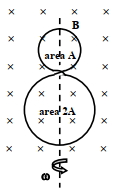
A circular insulated copper wire loop is twisted to form two loops of area $\mathrm{A}$ and $2 \mathrm{~A}$ as shown in the figure. At the point of crossing the wires remain electrically insulated from each other. The entire loop lies in the plane (of the paper). A uniform magnetic field $\vec{B}$ points into the plane of the paper. A uniform magnetic field $\vec{B}$ points into the plane of the paper. At $t=0$, the loop starts rotating about the common diameter as

axis with a constant angular velocity $\omega$ in the magnetic field. Which of the following options is/are correct?

(image)

[$A$] The rate of change of the flux is maximum when the plane of the loops is perpendicular to plane of the paper.

[$B$] The net emf induced due to both the loops is proportional to $\cos \omega t$.

[$C$] The emf induced in the loop is proportional to the sum of the areas of the two loops.

[$D$] The amplitude of the maximum net emf induced due to both the loops is equal to the amplitude of maximum emf induced in the smaller loop alone.
A point moves with uniform acceleration and ${v_1},\,{v_2}$ and ${v_3}$ denote the average velocities in the three successive intervals of time ${t_1},\,{t_2}$ and ${t_3}$. Which of the following relations is correct
A particle of mass $m$ is projected with velocity $v$ making an angle of ${45^o}$with the horizontal. The magnitude of the angular momentum of the particle about the point of projection when the particle is at its maximum height is (where $g = $ acceleration due to gravity)