Question
In Huygens' theory, light waves

Answer

(b) are longitudinal waves and require a medium to travel.
Explanation: According to Huygens, light waves are longitudinal waves and require a material medium to travel. For this reason Huygens assumed the existence of a hypothetical medium called luminiferous aether.

Need a full question paper?

Generate a complete, print-ready paper with questions like this in minutes — across 16+ boards, with answer keys.

Start Generating Free

Similar questions

The idea of parmanu was given by:
Total internal reflection of a ray of light is possible when the ($1_{c}$= critical angle, i= angle of incidence)
The de$-$Broglie wavelength of a particle moving with a velocity $2.25 \times 10^8 m/s$ is equal to the wavelength of photon. The ratio of kinetic energy of the particle to the energy of the photon is $($velocity of light is $3 \times 10^8 m/s)$
The magnetic field lines due to a bar magnet are correctly shown in
A vertical wire carries a current in upward direction. An electron beam sent horizontally towards the wire will be deflected:
If six identical cells each having an $e.m.f.$ of $6 V$ are connected in parallel, the $e.m.f.$ of the combination is
Assertion  :   For cooking in a microwave oven, food is always kept in metal containers.
Reason      : The energy of microwave is easily transferred to the food in metal container. (a) If both assertion and reason are true and the reason is the correct explanation of the assertion.(b) If both assertion and reason are true but reason is not the correct explanation of the assertion.(c) If assertion is true but reason is false.(d) If the assertion and reason both are false.


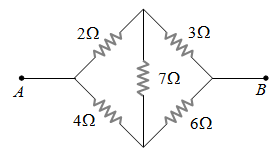
Five resistances are connected as shown in the figure. The effective resistance between the points $A$ and $B$ is
Consider the two idealized systems: (i) a parallel plate capacitor with large plates and small separation and (ii) a long solenoid of length L > > R, radius of cross-section. In (i) E is ideally treated as a constant between plates and zero outside. In (ii) magnetic field is constant inside the solenoid and zero outside. These idealised assumptions, however, contradict fundamental laws as below:
A concave lens and a convex lens have same focal length of 20 cm and both put in contact this combination is used to view an object 5 cm long kept at 20 cm from the lens combination. As compared to object the image will be (a) Magnified and inverted(b) Reduced and erect(c) Of the same size and erect (d) Of the same size and inverted