Question
In hydrogen atom, there is single electron only but many lines in its emission spectrum. How it does? Explain the reason.

Answer

Each atom have some definite energy levels. In normal state electron of hydrogen atom remains in low energy level. When atom gets energy from outside, electron jumps into higher energy level and leave the minimum energy level i.e. it becomes excited. Electron leave the higher energy level within $10^{-8} sec$. Now it can return in lowest energy level or can be return passing through the lower energy level to lowest one. Since, any light source (hydrogen lamp) has large numbers. of atoms therefore all possible transition initiates in source and many lines has seen in spectrum.

Need a full question paper?

Generate a complete, print-ready paper with questions like this in minutes — across 16+ boards, with answer keys.
Start Generating Free

Similar questions

Three simple harmonic motions of equal amplitudes A and equal time periods in the same direction combine. The phase of the second motion is 60° ahead of the first and the phase of the third motion is 60° ahead of the second. Find the amplitude of the resultant motion.
Draw diagrams to depict the behaviour of magnetic field lines near a ‘bar’ of: (i) Copper (ii) Aluminium (iii) Mercury, cooled to a very low temperature (4.2K)
A hot gas emits radiation of wavelengths 46.0nm, 82.8nm and 103.5nm only. Assume that the atoms have only two excited states and the difference between consecutive energy levels decreases as energy is increased. Taking the energy of the highest energy state to be zero, find the energies of the ground state and the first excited state.
A rod of length L is placed along the X-axis between x = 0 and x = L. The linear density (mass/ length) $\rho$ of the rod varies with the distance x from the origin as $\rho=\text{a + bx.}$
  1. Find the SI units of a and b.
  2. Find the mass of the rod in terms of a, b and L.
Using photon picture of light, show how Einstein’s photoelectric equation can be established. Write two features of photoelectric effect which cannot be explained by wave theory.
What is the de-Broglie wavelength associated with (a) an electron moving with a speed of $5.4 \times 10^6 m / s$, and (b) a ball of mass 150 g travelling at $ 30 . m / s$ ?
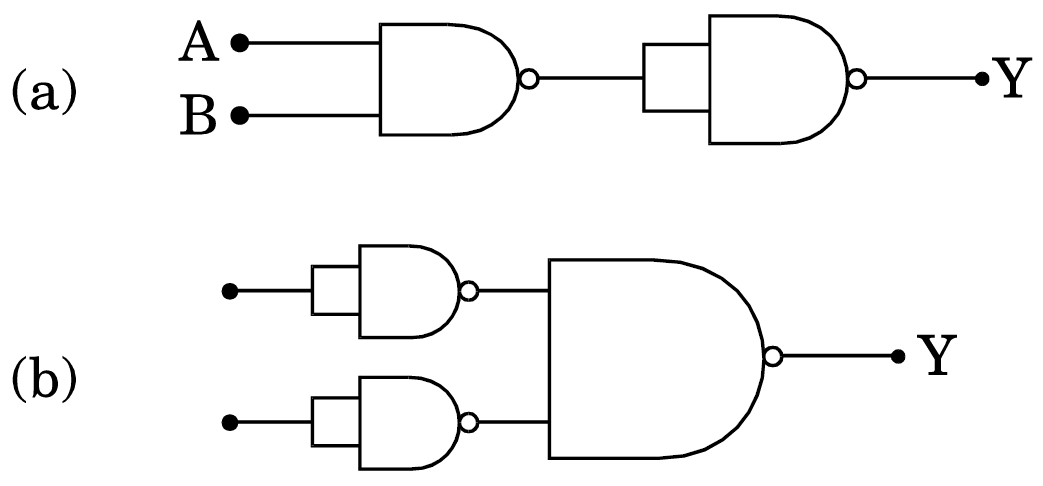
You are given two circuits (a) and (b) as shown in the figures, which consist of NAND gates. Identify the logic operation carried out by the two. Write the truth tables for each. Identify the gates equivalent to the two circuits.

Classify metals, conductors and semiconductors.
Does a nucleus lose mass when it suffers gamma decay?
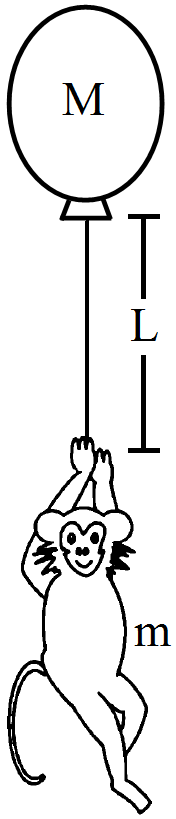
The balloon, the light rope and the monkey shown in figure are at rest in the air. If the monkey reaches the top of the rope, by what distance does the balloon descend ? Mass of the balloon = M, mass of the monkey = m and the length of the rope ascended by the monkey = L.