Question
In hydrogen atom, there is single electron only but many lines in its emission spectrum. How it does? Explain the reason.

Answer

Each atom have some definite energy levels. In normal state electron of hydrogen atom remains in low energy level. When atom gets energy from outside, electron jumps into higher energy level and leave the minimum energy level i.e. it becomes excited. Electron leave the higher energy level within $10^{-8} sec$. Now it can return in lowest energy level or can be return passing through the lower energy level to lowest one. Since, any light source (hydrogen lamp) has large numbers. of atoms therefore all possible transition initiates in source and many lines has seen in spectrum.

Need a full question paper?

Generate a complete, print-ready paper with questions like this in minutes — across 16+ boards, with answer keys.
Start Generating Free

Similar questions

A hydrogen atom emits ultraviolet radiation of wavelength 102.5nm. What are the quantum numbers of the states involved in the transition?
How does the resolving power of a compound microscope get affected on:
  1. Decreasing the diameter of its objective?
  2. Increasing the focal length of its objective?
A charge Q is distributed uniformly over a metallic sphere of radius R. Obtain the expressions for the electric field (E) and electric potential (V) at a point 0 < x < R.
Show on a plot the variation of E and V with x for 0 < x < 2R.
Find the ratio of the linear momenta of two particles of masses 1.0kg and 4.0kg if their kinetic energies are equal.
  1. What is total internal reflection? Under what conditions does it occur?
  2. Find a relation between critical angle and refractive index.
  3. Name one phenomenon which is based on total internal reflection.
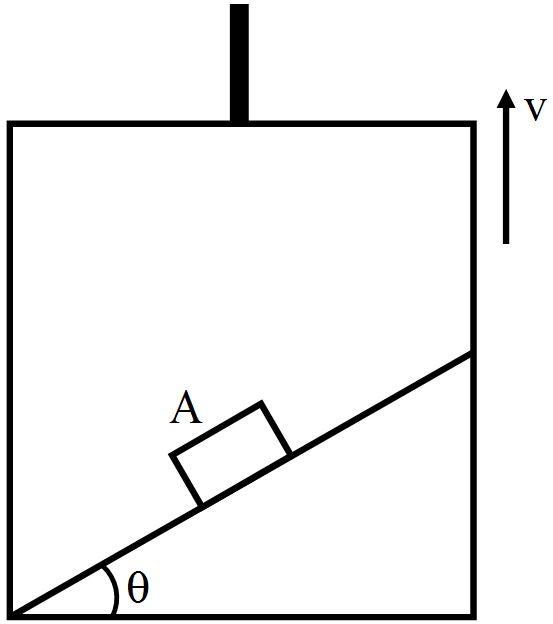
A block A can slide on a frictionless incline of angle $\theta$ and length l, kept inside an elevator going up with uniform velocity v. Find the time taken by the block to slide down the length of the incline if it is released from the top of the incline.

Establish the relation between critical angle and refractive index.
The force of surface tension acts tangentially to the surface whereas the force due to air pressure acts perpendicularly on the surface. How is then the force due to excess pressure inside a bubble balanced by the force due to the surface tension?
What length of a copper wire of cross-sectional area 0.01mm2 will be needed to prepare a resistance of $1\text{k}\Omega?$ Resistivity of copper $=1.7\times10^{-8}\Omega\text{-m}.$
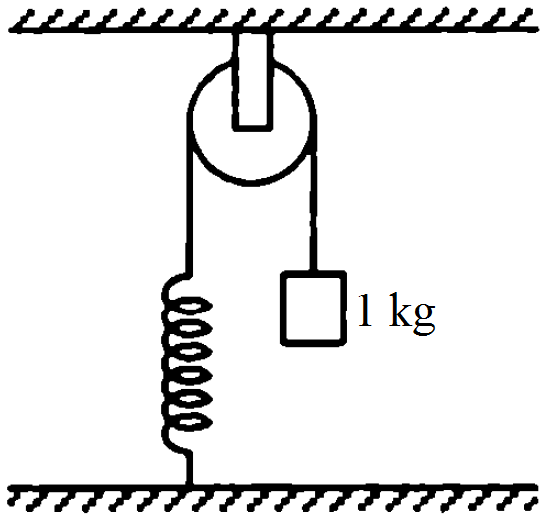
The pulley shown in figure has a radius of 20cm and moment of inertia 0.2kg-m2. The string going over it is attached at one end to a vertical spring of spring constant 50N/m fixed from below, and supports a 1kg mass at the other end. The system is released from rest with the spring at its natural length. Find the speed of the block when it has descended through 10cm. Take g = 10m/s2.