Question
How does the resolving power of a compound microscope get affected on:
  1. Decreasing the diameter of its objective?
  2. Increasing the focal length of its objective?

Answer

Resolving limit of microscope $=\frac{\lambda}{2\text{n}\sin\theta} $
Resolving power $\alpha\frac{1}{\text{Resolving limit}}$
i.e., Resolving power $=\frac{2\text{n}\sin\theta}{\lambda}$
  1. When diameter of objective lens decreases, θ and hence sinθ decreases; so the resolving power decreases.
  2. The focal length of objective lens has no effect on resolving power of microscope.

Need a full question paper?

Generate a complete, print-ready paper with questions like this in minutes — across 16+ boards, with answer keys.

Start Generating Free

Similar questions

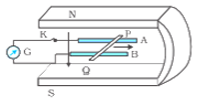
Figure shows a metallic rod PQ of length l, resting on the smooth horizontal rails AB positioned between the poles of a permanent magnet. The rails, the rod, and the magnetic field are in three mutually perpendicular directions. A galvanometer G connects the rails through a switch K. Assume the magnetic field to be uniform. Given the resistance of the closed-loop containing the rod is R.
Image

i. Suppose K is open and the rod is moved with a speed v in the direction shown. Find the polarity and magnitude of induced emf.
ii. With K open and the rod moving uniformly, there is no net force on the electrons in the rod PQ even though they do experience a magnetic force due to the motion of the rod. Explain.
iii. What is the induced emf in the moving rod if the magnetic field is parallel to the rails instead of being perpendicular?
Define the term magnetic inclination. Deduce the relation connecting the horizontal component and inclination with the help of a diagram.
A source of ac voltage v = v0 $\sin\omega t$, is connected across a pure inductor of inductance L. Derive the expressions for the instantaneous current in the circuit. Show that average power dissipated in the circuit is zero.
Define electric flux. Write its SI unit.
Using Gauss’s law, deduce an expression for electric field intensity due to an infinitely long straight uniformly charged wire.
A source emitting a sound of frequency v is placed at a large distance from an observer. The source starts moving towards the observer with a uniform acceleration a. Find the frequency heard by the observer corresponding to the wave emitted just after the source starts. The speed of sound in the medium is u.
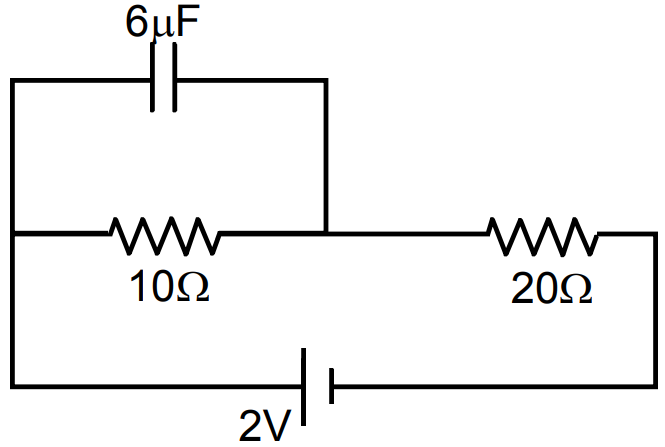
Find the charge on the capacitor shown in figure.

For a given position of an object, an equiconvex lens forms its real image at a distance of 60cm from the lens. A convex mirror is now kept in between this image position and the convex lens. The final image formed by this combination coincides with the object when the distance between the convex lens and the convex mirror equals 25cm. Calculate the radius of curvature of the convex mirror.
The magnetic field B inside a long solenoid, carrying a current of 5.00A, is 3.14 × 10⁻²T. Find the number of turns per unit length of the solenoid.
A parallel plate capacitor is charged to a potential difference V from a direct current source, while there is air between the plates. Without separating the capacitor from the battery, a dielectric medium of dielectric constant K has been filled in place of air. Explain with reasons which of the following changes will occur? Also give explanation of the answers.(i) Potential difference (ii) Electric field between the plates (iii) Capacitance (iv) charge (v) energy.
Give brief explanation of a semi-conductor diode.