MCQ
In hydrogen atom, when electron jumps from second to first orbit, then energy emitted is
  • A
    $-13.6\, eV$
  • B
    $-27.2\, eV$
  • C
    $-6.8\, eV$
  • None of these

Answer

Correct option: D.
None of these
d
${E_{{n_1} \to {n_2}}} = - 13.6\left[ {\frac{1}{{n_2^2}} - \frac{1}{{n_1^2}}} \right];{n_1} = 2$ & ${n_2} = 1$

$ \Rightarrow {E_{II}} \to {E_I} = - 13.6 \times \frac{3}{4} = - 10.2\;eV$

Need a full question paper?

Generate a complete, print-ready paper with questions like this in minutes — across 16+ boards, with answer keys.

Start Generating Free

Similar questions

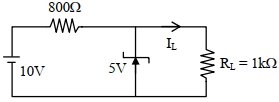
In the given circuit- the value of current $I _{ L }$ will be $mA$.

(When $R _{ L }=1 \,k\, \Omega$ )

The flat bottom of cylinder tank is silvered and water $(\mu = 4/3)$ is filled in the tank upto a height $h$ .$A$ small bird is hovering at a height $3h$ from the bottom of the tank. When a small hole is opened near the bottom of the tank, the water level falls at the rate of $1\, cm/s$. The bird will perceive that his image's velocity is :
$A$ and $B$ in the following reactions are
In simple harmonic motion, the ratio of acceleration of the particle to its displacement at any time is a measure of
A short magnet oscillates with a time period $0.1\, s$ at a place where horizontal magnetic field is $24\,\mu T.$ A downward current of $18 \,A$ is established in a vertical wire $20 \,cm$ east of the magnet. The new time period of oscillator
The angle between vectors $(\vec{M} \times \vec{N})$ and $(\bar{N} \times \vec{M})$ is ................
A $2\,kg$ chain is in the form of a heap. Its length is $2\,m$. Its one end is being pulled at constant speed of $2\,m/s$ horizontally. The power delivered to the chain is (in $W$).
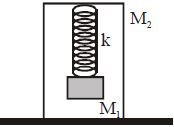
$A$ block of mass $M_1$ is hanged by a light spring of force constant $k$ to the top bar of a reverse Uframe of mass $M_2$ on the floor. The block is pooled down from its equilibrium position by $a$ distance $x$ and then released. Find the minimum value of $x$ such that the reverse $U$ -frame will leave the floor momentarily.
A black body radiates at the rate of $W$ watts at a temperature $T$ . If the temperature of the body is reduced to $T/3$ , it will radiate at the rate of (in Watts)
Four particles $A, B, C$ and $D$ each of mass $m$ are kept at the corners of a square of side $L$. Now the particle $D$ is taken to infinity by an external agent keeping the other particles fixed at their respective positions. The work done by the gravitational force acting on the particle $D$ during its movement is ..........