MCQ
In isothermal expansion, the pressure is determined by
  • A
    Temperature only
  • Compressibility only
  • C
    Both temperature and compressibility
  • D
    None of these

Answer

Correct option: B.
Compressibility only
(b) For such a case, pressure $=\frac{1}{\text { Compressibility }}$

Need a full question paper?

Generate a complete, print-ready paper with questions like this in minutes — across 16+ boards, with answer keys.
Start Generating Free

Similar questions

In adiabatic expansion of a gas
The state of the energy gained by valance electrons when the temperature is raised or when electric field is applied is called as
Adiabatic modulus of elasticity of a gas is $2.1 \times 10^5 \mathrm{~N} / \mathrm{m}^2$. What will be its isothermal modulus of elasticity $\left(\frac{C_p}{C_v}=1.4\right)$
Heat given to a system is $35$ joules and work done by the system is $15$ joules. The change in the internal energy of the system will be
The composition of two simple harmonic motions of equal periods at right angle to each other and with a phase difference of $\pi$ results in the displacement of the particle along
If the K.E. of a body is increased by $300 \%$, its momentum will increase by
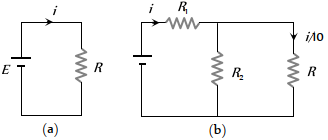
Consider the circuits shown in the figure. Both the circuits are taking same current from battery but current through $R$ in the second circuit is $\frac{1}{10}$ th of current through $R$ in the first circuit. If $R$ is $11 \Omega$, the value of $R$Image
The tension in a piano wire is $10 \mathrm{~N}$. What should be the tension in the wire to produce a note of double the frequency
A coil has $1,000$ turns and $500 \mathrm{~cm}$ as its area. The plane of the coil is placed at right angles to a magnetic induction field of $2 \times 10^{-5} \mathrm{~Wb} / \mathrm{m}^2$. The coil is rotated through $180^{\circ}$ in $0.2$ seconds. The average e.m.f. induced in the coil, in milli-volts, is
Two cylinders $A$ and $B$ fitted with pistons contain equal amounts of an ideal diatomic gas at $300 \mathrm{~K}$. The piston of $A$ is free to move while that of $B$ is held fixed. The same amount of heat is given to the gas in each cylinder. If the rise in temperature of the gas in $A$ is $30 \mathrm{~K}$, then the rise in temperature of the gas in $B$ is