MCQ
In isothermal, isobaric and adiabatic processes, the value of work done for equal volume change is minimum:
  • A
    Isothermal
  • B
    Isobaric
  • Adiabatic
  • D
    None of these

Answer

Correct option: C.
Adiabatic
C

Need a full question paper?

Generate a complete, print-ready paper with questions like this in minutes — across 16+ boards, with answer keys.
Start Generating Free

Similar questions

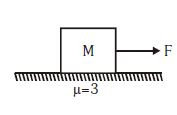
A block of mass $M$ placed on rough surface of coefficient of friction equal to $3$ . If $F$ is the $(4/5)$ of the minimum force required to just move. Find out the force exerted by ground on the block
The moment of inertia of a solid cylinder about its axis is $I$. It is allowed to roll down an incline without slipping. If its angular velocity at the bottom be $\omega $, then $K.E.$ of the cylinder will be
An object is projected upwards with a velocity of $100 \,m/s$. It will strike the ground after (approximately)........$sec$
If $\vec{a}$ and $\vec{b}$ makes an angle $\cos ^{-1}\left(\frac{5}{9}\right)$ with each other, then $|\vec{a}+\vec{b}|=\sqrt{2}|\vec{a}-\vec{b}|$ for $|\vec{a}|=n|\vec{b}|$ The integer value of $n$ is . . . . . . .. 
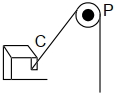
One end of massless rope, which passes over a massless and frictionless pulley $P$ is tied to a hook while the other is free. Maximum tension the rope bear is $360 N$. With what value of maximum safe acceleration (in $m s^{-2}$) can a man of $60 kg$ climb on the rope?
The weight of an empty balloon on a spring balance is W1. The weight becomes W2 when the balloon is filled with air. Let the weight of the Air itself be $\omega$ neglect the thickness of the balloon when it is filled with air. Also neglect the difference in the densities of air inside and outside the balloon.

  1. $\text{W}_2=\text{W}_1$

  2. $\text{W}_2=\text{W}_1+\omega$

  3. $\text{W}_2<\text{W}_1+\omega$

  4. $\text{W}_2>\text{W}_1$

Let $\overrightarrow{\text{C}}=\overrightarrow{\text{A}}+\overrightarrow{\text{B}}.$
  1. $|\overrightarrow{\text{C}}|$ is always greater than $|\overrightarrow{\text{A}}|$
  2. It is possible to have $|\overrightarrow{\text{C}}|<|\overrightarrow{\text{A}}|$ and $|\overrightarrow{\text{C}}|<|\overrightarrow{\text{B}}|$
  3. C is always equal to A + B
  4. C is never equal to A + B.
A body falling under gravity covers two points $A$ and $B$ separated by $80 \mathrm{~m}$ in $2 \mathrm{~s}$. The distance of upper point A from the starting point is________ $\mathrm{m}$ (use $\mathrm{g}=10 \mathrm{~ms}^{-2}$ )
A particle of mass Mkg describes a circle of radius 1m. The centripetal acceleration of the particle is 4m/ s2. What will be the momentum of the particle ?
Choose the correct alternatives: