Question types

PART - 2 CH - 11 Thermodynamics question types

168 questions across 8 question groups — pick any mix to generate a Physics paper with step-by-step answer keys.

168
Questions
8
Question groups
5
Question types
Sample Questions

PART - 2 CH - 11 Thermodynamics questions

One sample from each question group in this chapter. Select any group above to see the full set with answer keys.

If opened door of a refrigerator in working condition kept in an insulated room:
  • A
    The temperature of the room will reduce to a certain degree.
  • B
    The room can be cooled to the temperature of a refrigerator.
  • The room will become a little warmer.
  • D
    The room will be neither hot nor cold.

Answer: C.

View full solution
The initial pressure of a gas is P. It is adiabatic compressed due to which its density becomes four times its initial density. The final pressure of the gas will be: ${\gamma = 1.5}$
  • A
    4P
  • B
    16P
  • C
    2P
  • 8P

Answer: D.

View full solution
Which thermodynamic property has the same value in systems when they are in thermal equilibrium?
  • Heat
  • B
    Pressure
  • C
    Volume
  • D
    None of these

Answer: A.

View full solution
If the specific heats per gram of an ideal gas of molecular weight M are represented by Cp and $C _{ \text v }$ then :
  • A
    $C _{ P }- C _{ V }=\frac{ R }{ M ^2}$
  • B
    $C _{ P }- C _{ V }= R$
  • $C_p-C_V=\frac{R}{M}$
  • D
    $C _{ P }- C _{ V }= MR$

Answer: C.

View full solution
Which of the following processes is irreversible?
  • A
    Slow isothermal change
  • B
    Slow adiabatic change
  • C
    Evaporation process
  • Diffusion of gases

Answer: D.

View full solution
Explain why :
The coolant in a chemical or a nuclear plant (i.e., the liquid used to prevent the different parts of a plant from getting too hot) should have high specific heat.
View full solution
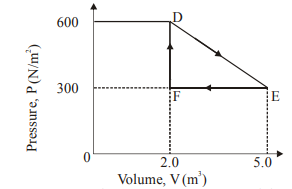
A thermodynamic system is taken from an original state to an intermediate state by the linear process shown in Fig.
Image

Its volume is then reduced to the original value from E to F by an isobaric process. Calculate the total work done by the gas from D to E to F.
View full solution
An electric heater supplies heat to a system at a rate of 100W. If system performs work at a rate of 75 joules per second. At what rate is the internal energy increasing?
View full solution
Explain why :
Two bodies at different temperatures $T_1$ and $T_2$ if brought in thermal contact do not necessarly settle to the mean temperature $\left(T_1+T_2\right) / 2$.
View full solution
A thermos flask is filled with water. The thermos is shaken for some time due to which the temperature of the water increases. Give reasons. (i) Was work done on water? (ii) Was heat given to water? (iii) Will the internal energy of water increases?
View full solution
Q 263 Marks Question3 Marks
Two cylinders A and B of equal capacity are connected to each other via a stopcock. A contains a gas at standard temperature and pressure. B is completely evacuated. The entire system is thermally insulated. The stopcock is suddenly opened. Answer the following :
(a) What is the final pressure of the gas in A and B?
(b) What is the change in internal energy of the gas?
(c) What is the change in the temperature of the gas?
(d) Do the intermediate states of the system (before settling to the final equilibrium state) lie on its P-V-T surface?
View full solution
Q 273 Marks Question3 Marks
In changing the state of a gas adiabatically from an equilibrium state $A$ to another equilibrium state $B$, and amount of work equal to 22.3 J is done on the system. If the gas is taken from state A to B via a process in which the net heat absorbed by the system is 9.35 cal, how much is the net work done by the system in the latter case? $($ Take $1 cal =4.19 J)$
View full solution
Q 283 Marks Question3 Marks
A cylinder with a movable piston contains 3 moles of hydrogen at standard temperature and pressure. The walls of the cylinder are made of a heat insulator, and the piston is insulated by having a pile of sand on it. By what factor does the pressure of the gas increase if the gas is compressed to half its original volume?
View full solution
Q 293 Marks Question3 Marks
What amount of heat must be supplied to $2.0 \times 10^{-2} kg$ of nitrogen (at room temperature) to raise its temperature by $45^{\circ} C$ at constant pressure? (Molecular mass of $N _2=28 ; R =8.3 J mol ^{-1} K^{-1}$ ).
View full solution
AB
1. Efficiency of heat engine $\eta=$(A) $\frac{\Delta P}{\Delta V}$
2. The slope of the adiabatic curve is greater than the isothermal curve(B) Zero
3. Value of W for isochoric process will be(C) $\frac{ Q _2}{ Q _1- Q _2}$
4. The value of performance coefficient $\alpha$ of the refrigerant will be(D) Equal to initial value
5. The working fluid has internal energy after completing the Carnot cycle(E)  $\frac{ W }{ Q }$
View full solution
AB
1. A thermos bottle filled with tea is shaken vigorously in the internal energy of the system(A) dQ = 0
2. In adiabatic compression of the body increases(B) will increase
3. For isothermal operation of the engine(C) heat
4. Work done in isothermal process(D) $T _1= T _2$
5. In adiabatic change of gas specific heat value happens zero because(E)$\begin{array}{l} 2.303 P _1 V_1  \log 10 \frac{V_2}{V_1}\end{array}$
View full solution
A geyser heats water flowing at the rate of 3.0 liters per minute from $27^{\circ} C$ to $77^{\circ} C$. If the geyser is operated by a gas burner, what is the rate of consumption of the fuel if its heat of combustion is $4.0 \times 10^4 J / g$ ?
View full solution
0.1 gm molecule of diatomic gas is isothermally expanded at 293 K to twice its initial volume. After that its adiabatic expansion is done until the final volume becomes four times the initial volume. Find the final temperature of the gas and also calculate the work done for both the expansion ( $R = 8 . 3$ joule $m o l ^{ l } K ^{-1}$, $\gamma=1.4)$
View full solution
Prove that at any point in the PV diagram, the slope of the adiabatic curve is $\gamma$ times the slope of the isothermal curve. Make necessary diagram.
View full solution

Generate a PART - 2 CH - 11 Thermodynamics paper free

Pick question groups from the list above, set marks and difficulty, and export a branded PDF with step-by-step answer keys. First 3 chapters free — no signup.

Download App