MCQ
In Jager's method, at the time of bursting of the bubble
  • The internal pressure of the bubble is always greater than external pressure
  • B
    The internal pressure of the bubble is always equal to external pressure
  • C
    The internal pressure of the bubble is always less than external pressure
  • D
    The internal pressure of the bubble is always slightly greater than external pressure

Answer

Correct option: A.
The internal pressure of the bubble is always greater than external pressure
a
In Jager's method, at the time of bursting of the bubble The internal pressure of the bubble is always greater than external pressure.

Need a full question paper?

Generate a complete, print-ready paper with questions like this in minutes — across 16+ boards, with answer keys.

Start Generating Free

Similar questions

A body rolls down an inclined plane without slipping. The fraction of total energy associated with its rotation will be:
At what distance above and below the surface of the earth a body will have same weight, (take radius of earth as $R$.)
The proper use of lubricants cannot reduce:
If the time period $t$ of the oscillation of a drop of liquid of density $d$, radius $r$, vibrating under surface tension $s$ is given by the formula $t = \sqrt {{r^{2b}}\,{s^c}\,{d^{a/2}}} $ . It is observed that the time period is directly proportional to $\sqrt {\frac{d}{s}} $ . The value of $b$ should therefore be
A man is swinging on a swing made of $2$ ropes of equal length $L$ and in direction perpendicular to the plane of paper. The time period of the small oscillations about the mean position is
A ball dropped from some height coves half of its total during the last second of its free fall. Find:
Two soap bubbles $A$ and $B$ are formed at the two open ends of a tube. The bubble $A$ is smaller than bubble $B.$ If the value on the tube connecting the two bubbles is opened and air can flow freely between the bubbles, then:
Bernoulli's principle does not explain
A normal eye is not able to see objects closer than 25cm because:
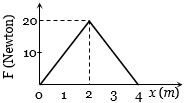
The graph between the resistive force $ F$ acting on a body and the distance covered by the body is shown in the figure. The mass of the body is $25\, kg$ and initial velocity is $2\, m/s$. When the distance covered by the body is $4m$, its kinetic energy would be .............. $\mathrm{J}$