MCQ
In laboratory silicon can be prepared by the reaction
  • Silica with magnesium
  • B
    By heating carbon in electric furnace
  • C
    By heating potassium fluosilicate with potassium
  • D
    None of these

Answer

Correct option: A.
Silica with magnesium
a
(a) $Si{O_2} + 2Mg \to Si + 2MgO$.

Need a full question paper?

Generate a complete, print-ready paper with questions like this in minutes — across 16+ boards, with answer keys.
Start Generating Free

Similar questions

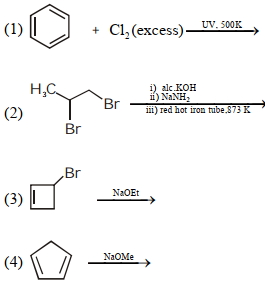
Choose the correct option($s$) that give($s$) an aromatic compound as the major product.
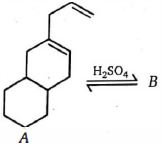
$A$ isomerise to $B$ on addition of traces of acid $H_2SO_4$. Compound $(B)$ is
Among the elements $Ca, Mg, P$ and $Cl,$ the order of increasing atomic radii is
Standard entropy of $X_2, Y_2$ and $XY_3$ are $60, 40$ and $50\,J \,K^{-1}\,mol^{-1},$ respectively. For the reaction,

$\frac{1}{2}{X_2} + \frac{3}{2}{Y_2} \to X{Y_3},\,\Delta H =  - 30\,kJ$ , to be at equilibrium, the temperature will be ............... $\mathrm{K}$

A first order reaction which is $ 30\%$ complete in $30$  minutes has a half-life period of .............. $\min.$
Metallic nature and basic nature of the oxides ........ as we move along a period
Zinc reacts with hydrochloric acid to give hydrogen and zinc chloride. The volume of hydrogen gas produced at $STP$ from the reaction of $11.5\,g$ of zinc with excess $HCl$ is $..........L$ (Nearest integer) (Given : Molar mass of $Zn$ is $65.4\,g\,mol ^{-1}$ and Molar volume of $H _2$ at $STP =22.7\,L$ )
$\begin{array}{*{20}{c}}
  {C{H_3} - CH - CH = C{H_2}} \\ 
  {|\,\,\,\,\,\,\,\,\,\,\,\,\,\,\,\,\,\,\,\,} \\ 
  {C{H_3}\,\,\,\,\,\,\,\,\,\,\,\,\,\,} 
\end{array}$ $\xrightarrow{{{\text{D}}Br}}\,Product \,\left( {Major} \right)$ Product will be
$CH_3 CH_2CH(OH)CH(CH_3)_2 + CH_3COCl \xrightarrow{base} $ $CH_3CH_2CH(OCOCH_3 )CH(CH_3)_2 + HCl$

In the above reaction, if the reactant alcohol is a pure $R-$ isomer the product would.

Maximum oxidation state of $Cr$  is