In meter bridge or Wheatstone bridge for measurement of resistance, the known and the unknown resistances are interchanged. The error so removed is
Easy


Download our appand get started for free
Experience the future of education. Simply download our apps or reach out to us for more information. Let's shape the future of learning together!No signup needed.*
Similar Questions
- 1A capacitor is connected to a cell of $emf$ $E$ having some internal resistance $r$. The potential difference across theView Solution
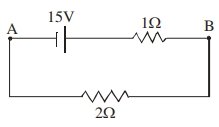
- 2For the network shown below, the value $V _{ B }- V _{ A }$ is_______ $V$View Solution
- 3Time taken by a $836\; W$ heater to heat $1\; litre$ of water from $10^{\circ} C$ to $40^{\circ} C$ isView Solution
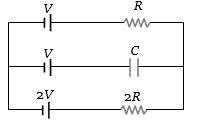
- 4View SolutionIn the given circuit, with steady current, the potential drop across the capacitor must be
- 5A certain piece of silver of given mass is to be made like a wire. Which of the following combination of length $(L)$ and the area of cross-sectional $(A) $ will lead to the smallest resistanceView Solution
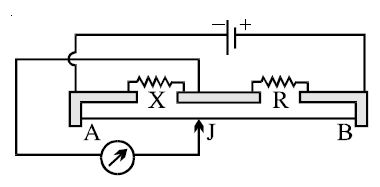
- 6The figure shows a meter-bridge circuit, with $AB = 100\, cm$,$ X = 12\,\Omega$ and $R = 18\,\Omega$ , and the jockey $J$ in the position of balance. If $R$ is now made $8\,\Omega$ , through what distance will $J$ have to be moved to obtain balance? .............. $cm$View Solution
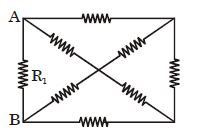
- 7As shown, the circuit is made of $8$ different resistors. It is found that when $R_1 = 4\,\,\Omega,$ the resistance between $A$ and $B$ is $2\,\,\Omega.$ Now replace $R_1$ by a $6\,\,\Omega$ resistor, what is the resistance between $A$ and $B$?View Solution
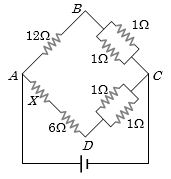
- 8For what value of unknown resistance $X$, the potential difference between $B$ and $D$ will be zero in the circuit shown in the figure ............... $\Omega$View Solution
- 9View SolutionOhm's law is true
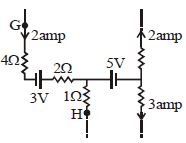
- 10In the part of a circuit shown in the figure, the potential difference $(V_G -V_H)$ between points $G$ and $H$ will be ............... $V$View Solution