MCQ
In $n-$type of semiconductor, majority carries are:
  • A
    Positron
  • Electron
  • C
    Holes
  • D
    Impure particles

Answer

Correct option: B.
Electron
In $n-$type semiconductor, large number of free electrons is present. Hence, free electrons are the majority charge carriers in the $n-$type semiconductor. The free electrons $($majority charge carriers$)$ carry most of the electric charge or electric current in the $n-$type semiconductor.

Need a full question paper?

Generate a complete, print-ready paper with questions like this in minutes — across 16+ boards, with answer keys.
Start Generating Free

Similar questions

The Sun's mean density is:
A long solenoid has $100\,turns/m$ and carries current $i.$ An electron moves with in the solenoid in a circle of radius $2·30\,cm$ perpendicular to the solenoid axis. The speed of the electron is $0·046\,c$ ($c =$ speed of light). Find the current $i$ in the solenoid (approximate).....$A$
Dispersion can take place for
The magnetic moment $(\mu)$ of a revolving electron around the nucleus varies with principal quantum number n as
Two copper balls, each weighing $10\,g$ are kept in air $10\, cm$ apart. If one electron from every ${10^6}$ atoms is transferred from one ball to the other, the coulomb force between them is (atomic weight of copper is $63.5$)
$A$ thin prism of angle $5^o$ is placed at a distance of $10\,cm$ from object. What is the distance of the image from object? (Given $\mu$ of prism $= 1.5$)
Which of the following is diamagnetism
A charged particle is moved along a magnetic field line. The magnetic force on the particle is:
An amplitude modulated wave is represented by the expression $v_{m}=5(1+0.6 \cos 6280 t) \sin \left(211 \times 10^{4} t \right)\; volts$. The minimum and maximum amplitudes of the amplitude modulated wave are, respectively
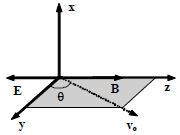
In a certain region uniform electric field $E$ and magnetic field $B$ are present in the opposite direction. At the instant $t = 0,$ a particle of mass $m$ carrying a charge $q$ is given velocity $v_o$ at an angle $\theta ,$ with the $y$ axis, in the $yz$ plane. The time after which the speed of the particle would be minimum is equal to