MCQ
In nuclear reaction $_2H{e^4}{ + _z}{X^A}{ \to _{z + 2}}{Y^{A + 3}} + A,\;A$ denotes
  • A
    Electron
  • B
    Positron
  • C
    Proton
  • Neutron

Answer

Correct option: D.
Neutron
d
(d) The given equation is $_2H{e^4}{ + _z}{X^A}{ \to _{z + 2}}{Y^{A + 3}} + A$ 

Applying charge and mass conservation

$4 + A = A + 3 + x \Rightarrow x = 1$

==> $2 + z = z + 2 + n \Rightarrow n = 0$ 

Hence $A$ is a neutron.

Need a full question paper?

Generate a complete, print-ready paper with questions like this in minutes — across 16+ boards, with answer keys.

Start Generating Free

Similar questions

If an observer is walking away from the plane mirror with $6\;m/sec.$ Then the velocity of the image with respect to observer will be........$m/sec$
Match List $I$ with List $II$.

List $I$ (Spectral Lines of Hydrogen for transitions from) List $II$ (Wavelengths ($nm$))
$A$ $n_2=3 \text { to } n_1=2$ $I$ $410.2$
$B$ $n_2=4 \text { to } n_1=2$ $II$ $434.1$
$C$ $n_2=5 \text { to } n_1=2$ $III$ $656.3$
$D$ $n_2=6 \text { to } n_1=2$ $IV$ $486.1$

Choose the correct answer from the options given below:

Electronic configuration of germanium is $2, 8, 18$ and $4$. To make it extrinsic semiconductor small quantity of antimony is added
For the reaction given below :

The compound which is not formed as a product in the reaction is a :
A particle located at $x = 0,$ at time $t = 0,$ starts moving along the positive $X-$ direction with a velocity $v$ that varies as $v\, = \,\alpha \sqrt x $. The displacement of the particle with time is proportional to
A body starts from origin and moves along $x$-axis so that its position at any instant is $x=4 t^2-12 t$ where $t$ is in second and $v$ in m/s. What is the acceleration of particle is ............. $m / s ^2$
A cube is resting on an inclined plane. What must be the value of coefficient of friction between cube and plane so that cube topples before sliding
In the solar system, which is conserved
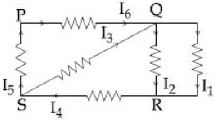
In the given circuit diagram, the currents, ${I_1} =  - \,0.3\,A,\,{I_4} = 0.8\,A$ and ${I_5} = 0.4\,A,$ are flowing as shown. The currents $I_2,\,I_3$ and $I_6,$ respectively are
Six charges are placed at the corner of a regular hexagon as shown. If an electron is placed at its centre $O$, force on it will be: