A cube is resting on an inclined plane. What must be the value of coefficient of friction between cube and plane so that cube topples before sliding
Medium
Download our app for free and get started
The given condition takes place when line of force of mg passes through
$\theta=45^{\circ}$ $...(i)$
and $\operatorname{mg} \sin \theta \leq f_{\mathrm{r} \max }=\mu \mathrm{mg} \cos \theta$
$\Rightarrow \mu \geq \tan \theta$
$\Rightarrow \mu \geq 1$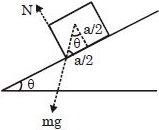

Download our appand get started for free
Experience the future of education. Simply download our apps or reach out to us for more information. Let's shape the future of learning together!No signup needed.*
Similar Questions
- 1View SolutionA metal block is resting on a rough wooden surface. A horizontal force applied to the block is increased uniformly. Which of the following curves correctly represents velocity of the block ?
- 2A block of mass $m$ slides along a floor while a force of magnitude $F$ is applied to it at an angle $\theta$ as shown in figure. The coefficient of kinetic friction is $\mu_{ K }$. Then, the block's acceleration $'a'$ is given by: ($g$ is acceleration due to gravity)View Solution

- 3A block rests on a rough inclined plane making an angle of ${30^o}$ with the horizontal. The coefficient of static friction between the block and the plane is $0.8$. If the frictional force on the block is $10 \,N$, the mass of the block (in kg) is (take $g = 10\,\,m/{s^2})$View Solution
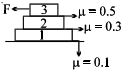
- 4If force $F$ is increasing with time and at $t = 0 , F = 0$ where will slipping first start?View Solution
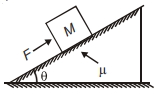
- 5A block (mass $=M kg$ ) is placed on a rough inclined plane. A force $F$ is applied parallel to the inclined (as shown in figure) such that it just starts moving upward. The value of $F$ isView Solution
- 6A block of mass $70\,kg$ is kept on a rough horizontal surface $(\mu = 0.4)$. A person is trying to pull the block by applying a horizontal force, but the block is not moving. The net contact force exerted by the surface on the block is $F$, thenView Solution
- 7A body of $10\, kg$ is acted by a force of $129.4\, N$ if $g = 9.8\,m/{\sec ^2}$. The acceleration of the block is $10\,m/{s^2}$. What is the coefficient of kinetic frictionView Solution
- 8View SolutionA man balances himself in a horizontal position by pushing his hands and feet against two parallel walls. His centre of mass lies midway between the walls. The coefficients of friction at the walls are equal. Which of the following is not correct?

- 9A block starts moving up an inclined plane of inclination $30^{\circ}$ with an initial velocity of $v_{0}$. It comes back to its initial position with velocity $\frac{v_{0}}{2} .$ The value of the coefficient of kinetic friction between the block and the inclined plane is close to $\frac{ I }{1000},$ The nearest integer to $I$ is......View Solution
- 10A motor cyclist moving with a velocity of $72\, km/hour$ on a flat road takes a turn on the road at a point where the radius of curvature of the road is $20$ meters. The acceleration due to gravity is $10 m/sec^2$. In order to avoid skidding, he must not bend with respect to the vertical plane by an angle greater thanView Solution