Question
In order to emit the electron from the metallic surface, which physical methods are used to give the minimum energy? Explain.

Answer

The minimum energy can be given by one of the following methods :
I. Thermionic emission
II. Field emission
III. Photoelectric emission.
I. Thermionic emission : Through thermionic emission, sufficient thermal energy can be given to the free electrons, so that they can come out of the metal.
II. Field emission : A strong electric field of the order of $10^8$ volts applied on a metal can emit electrons from the metal surface. As occurs in a spark plug.
III. Photoelectric emission : When light of appropriate frequency falls on a metal surface, electrons are emitted. These light generated electrons are called photoelectrons.

Need a full question paper?

Generate a complete, print-ready paper with questions like this in minutes — across 16+ boards, with answer keys.
Start Generating Free

Similar questions

A metal sphere of radius R is charged to a potential V:
  1. Find the electrostatic energy stored in the electric field within a concentric sphere of radius 2R.
  2. Show that the electrostatic field energy stored outside the sphere of radius 2R equals that stored within it.
Two identical particles, each having a charge of $2.0 \times 10^{-4}C$ and mass of $10g,$ are kept at a separation of $10\ cm$ and then released. What would be the speeds of the particles when the separation becomes large?
Find the,
  1. maximum frequency, and
  2. minimum wavelength of $X-$ rays produced by $30 kV$ electrons.
A light ray falling at an angle of $45^\circ$ with the surface of a clean slab of ice of thickness $1m$ is refracted into it at an angle of $30^\circ$ . Calculate the time taken by the light rays, to cross the slab. Speed of light in vacuum $= 3 \times 10^8\ m/s$
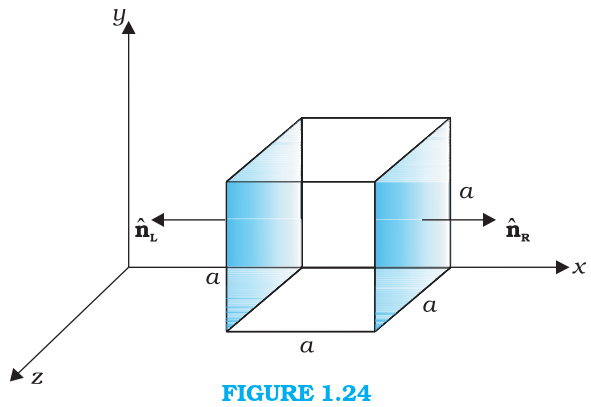
The electric field components in Fig. $1.24$ are $E_x=\alpha x^{1 / 2}, E_y=E_z=0$, in which $\alpha=800 N / C m ^{1 / 2}$. Calculate $(a)$ the flux through the cube, and $(b)$ the charge within the cube. Assume that $a=0.1 m$.
Image
What is the energy of a hydrogen atom in the first excited state if the potential energy is taken to be zero in the ground state?
Find the energy, the frequency and the momentum of an X-ray photon of wavelength 0.10nm.
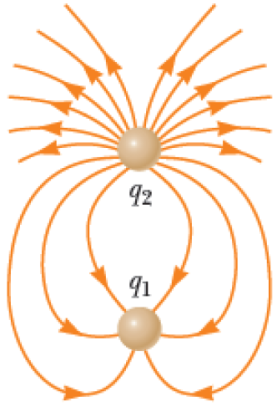
Consider the situation shown in figure. What are the signs of $q_1$ and $q_2\ ?$ If the lines are drawn in proportion to the charge, what is the ratio $\frac{\text{q}_1}{\text{q}_2}?$
A 12.5 eV electron beam is used to bombard gaseous hydrogen at room temperature. Upto which energy level the hydrogen atoms would be excited? Calculate the wavelengths of the first member of Lyman and first member of Balmer series.
A coil of inductance 5.0mH and negligible resistance is connected to the oscillator of the previous problem. Find the peak currents in the circuit for $\omega=100\text{s}^{-1},500\text{s}^{-1},1000\text{s}^{-1}.$