Question
In order to have a current in a long wire, it should be connected to a battery or some such device. Can we obtain the magnetic due to a straight, long wire by using Ampere's law without mentioning this other part of the circuit?

Answer

We can obtain a magnetic field due to a straight, long wire using Ampere's law by mentioning the current flowing in the wire, without emphasising on the source of the current in the wire. To apply Ampere's circuital law, we need to have a constant current flowing in the wire, irrespective of its source.

Need a full question paper?

Generate a complete, print-ready paper with questions like this in minutes — across 16+ boards, with answer keys.
Start Generating Free

Similar questions

A plate of thickness t made of a material of refractive index $\mu$ is placed in front of one of the slits in a double slit experiment.
  1. Find the change in the optical path due to introduction of the plate.
  2. What should be the minimum thickness t which will make the intensity at the centre of the fringe pattern zero? Wavelength of the light used is $\lambda$. Neglect any absorption of light in the plate.
Explain simple microscope. Obtain the equation of magnification for the image formed at near point.
State the principle of working of a cyclotron. Write two uses of this machine.
Why do stable nuclei never have more protons than neutrons?
How does the energy stored in a capacitor change if after disconnecting the battery, the plates of a charged capacitor are moved farther?
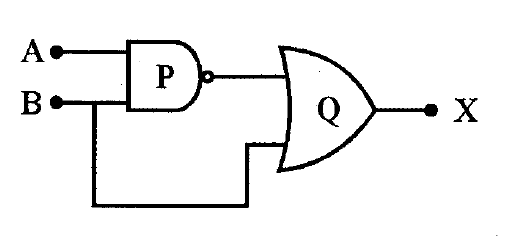
Identify the logic gates marked 'P' and 'Q' in the given circuit. Write the truth table for the combination.
Two voltameters, one having a solution of silver salt and the other of a trivalent-metal salt, are connected in series and a current of 2A is maintained for 1.50 hours. It is found that 1.00g of the trivalent-metal is deposited.
  1. What is the atomic weight of the trivalent metal?
  2. How much silver is deposited during this period? Atomic weight of silver is 107.9 g/mole.
The rest mass of the photon is zero. Explain it.
A farsighted person cannot see objects placed closer to 50cm. Find the power of the lens needed to see the objects at 20cm.
If two bodies are in thermal equilibrium in one frame, will they be in thermal equilibrium in all frames?